How Immigration Status Affects the Lifetime Capital Gains Exemption
Tax residency, not immigration status, determines who can claim this valuable exemption.

The Lifetime Capital Gains Exemption shelters up to roughly $625,000 of taxable capital gain per person on qualifying business shares, worth around $330,000 of personal tax at top marginal rates in Ontario or BC Lifetime Capital Gains Exemption in 2026: What Canadian Business Owners Need to Know Lifetime Capital Gains Exemption (LCGE) in Canada — 2026 Rules & Strategy. Whether an owner can actually use it, though, hinges on a question that has nothing to do with citizenship or visa status: is that person a Canadian tax resident, and for how long? How Immigration Status Affects the Lifetime Capital Gains Exemption.
Tax Residency, Not Immigration Status, as the Right Frame for the LCGE
110.6, available to individuals (not corporations) who sell qualifying property: primarily QSBC shares in a Canadian-controlled private corporation. For 2026, the indexed limit is approximately $1,275,000 per eligible individual Lifetime Capital Gains Exemption in 2026: What Canadian Business Owners Need to Know Lifetime Capital Gains Exemption (LCGE) in Canada — 2026 Rules & Strategy. At the 50% inclusion rate currently in force, that shelters about $625,000 of taxable gain, which translates to something in the neighborhood of $330,000 of tax avoided at top provincial rates Lifetime Capital Gains Exemption in 2026: What Canadian Business Owners Need to Know Lifetime Capital Gains Exemption (LCGE) in Canada — 2026 Rules & Strategy.
The word "immigration" does not appear anywhere in the operative statute. A permanent resident or a foreign national on a work permit who is a Canadian tax resident can claim the LCGE. Meanwhile, a Canadian citizen who has moved abroad and become a non-resident for tax purposes cannot claim it, even against property sitting inside a Canadian corporation. Citizenship, passport, permanent resident card: none of it matters to the statute. What matters is whether the individual was resident in Canada throughout the year of disposition under section 110.6, and once tax residency is established, immigration class becomes irrelevant to the calculation.
This distinction is the entire frame for the rest of what follows, not a hedge or a technicality to skim past. It is the entire frame for the rest of what follows. Every section below traces a different immigration event, arriving, leaving, arriving and leaving again within a short window, back to this single mechanism: does the event change tax residency, and if so, when? No CRA form or specific filing mechanic belongs here; those are attached later to the events where they actually apply. A Guide for CCPC Sellers and Claiming the Lifetime Capital Gains Exemption (LCGE) are covered by TurboTax® Canada Tips Claiming the Lifetime Capital Gains Exemption (LCGE) | TurboTax® Canada Tips.
The QSBC and CCPC tests that must be met regardless of who the owner is
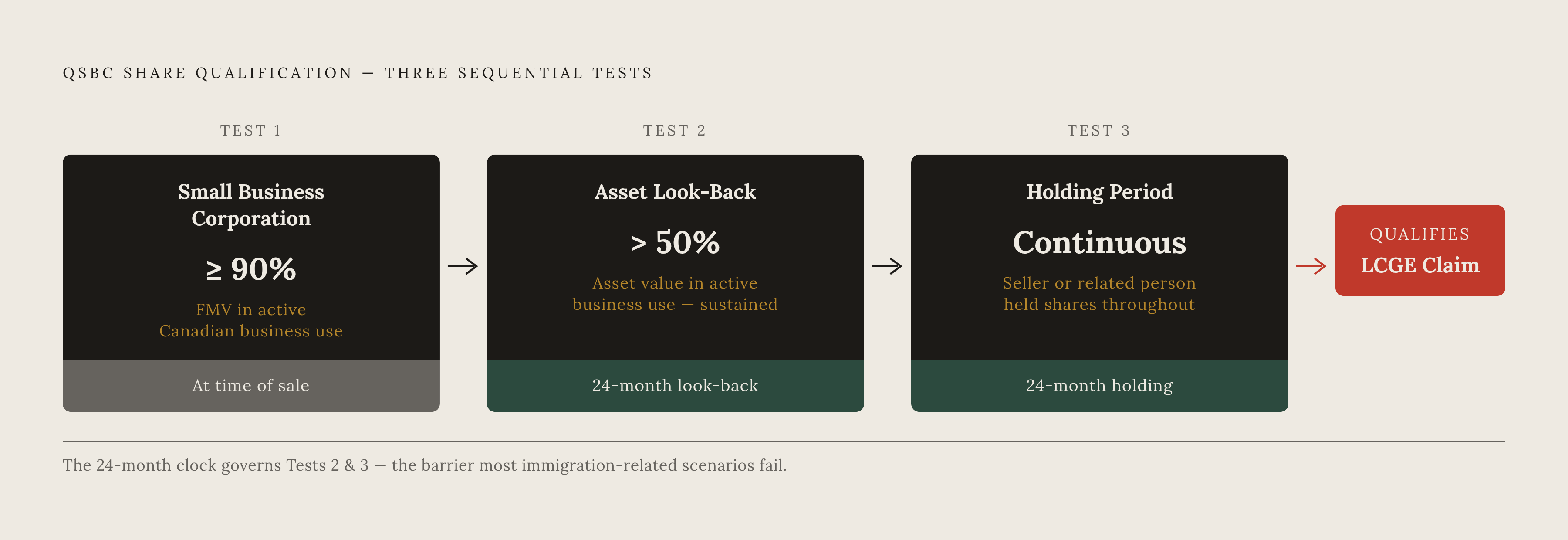
Before residency status can even become relevant, the shares themselves have to clear a separate, demanding set of hurdles. Three tests govern whether shares qualify as QSBC shares, and all three must pass.
The first is the Small Business Corporation test, measured at the time of sale: 90% or more of the fair market value of the corporation's assets must be used principally in an active business carried on primarily in Canada Lifetime Capital Gains Exemption (LCGE) in Canada — 2026 Rules & Strategy. The second looks backward over the 24 months before the sale, requiring that more than 50% of asset value have been in active business use throughout that window Lifetime Capital Gains Exemption (LCGE) in Canada — 2026 Rules & Strategy Lifetime Capital Gains Exemption 2026 — $1.275M Limit. This is where otherwise-healthy companies trip: a business that has quietly built up a large cash reserve, or holds investments unrelated to its operations, can fail this test even while running a profitable, functioning operation Lifetime Capital Gains Exemption (LCGE) in Canada — 2026 Rules & Strategy Lifetime Capital Gains Exemption 2026 — $1.275M Limit. The third test is a holding period requirement, the shares must have been owned by the seller or a related person throughout those same 24 months immediately preceding the sale Lifetime Capital Gains Exemption (LCGE) in Canada — 2026 Rules & Strategy Lifetime Capital Gains Exemption 2026 — $1.275M Limit.
Here is where the immigration angle sneaks back in even before residency of the seller becomes the issue. CCPC status is sensitive to the residency of shareholders generally, so if non-resident investors hold a control block, CCPC status can break for every shareholder in the company, not just the non-resident ones. That is a fact pattern specific enough that it needs professional verification rather than a general rule of thumb.
Being a CCPC does not automatically make shares QSBC-eligible. QSBC is a narrower, stricter standard focused on what the company's assets are actually doing, and for how long. These tests, particularly the 24-month windows, are the stage on which every immigration-related scenario in this piece plays out Lifetime Capital Gains Exemption (LCGE) in Canada — 2026 Rules & Strategy Lifetime Capital Gains Exemption 2026 — $1.275M Limit. Skipping past them means the residency rules that follow will not make much sense Lifetime Capital Gains Exemption (LCGE) in Canada — 2026 Rules & Strategy Lifetime Capital Gains Exemption 2026 — $1.275M Limit. Under S1, the corporation must be a Canadian-Controlled Private Corporation (CCPC): private, incorporated in Canada, not controlled by non-residents or public corporations.
Effect of a New Arrival's Residency Year on LCGE Eligibility in the Year of Immigration
Here is an obvious wrinkle. A new arrival cannot be "resident throughout the year" in the year they arrive, which should disqualify them from the LCGE in that year.
The Income Tax Act anticipates this. Subsection 110.6(5) provides a deeming rule: a taxpayer is treated as having been resident throughout the year if they were resident at any point during that year and resident throughout either the year before or the year after. So, in principle, a new immigrant can claim the LCGE in the very year they arrive, for a gain realized after landing. But a large caveat sits right behind that door.
For the deeming rule to actually help, the shares being sold must already qualify as QSBC shares, and that means the corporation has to already be a CCPC, with the 24-month holding period and asset test already satisfied before the sale Lifetime Capital Gains Exemption (LCGE) in Canada — 2026 Rules & Strategy Lifetime Capital Gains Exemption 2026 — $1.275M Limit. Consider what that means for someone who just moved to Canada holding shares in a company built elsewhere Lifetime Capital Gains Exemption in 2026: What Canadian Business Owners Need to Know Lifetime Capital Gains Exemption (LCGE) in Canada — 2026 Rules & Strategy. The corporation was almost certainly not a CCPC during the relevant 24-month look-back period Lifetime Capital Gains Exemption (LCGE) in Canada — 2026 Rules & Strategy Lifetime Capital Gains Exemption 2026 — $1.275M Limit. The deeming rule removes one obstacle and leaves the much larger one standing.
Anyone uncertain about their residency status in the year they arrived should start with Form NR74, the CRA's tool built specifically for that determination, rather than guessing based on days spent in the country. The honest takeaway here is that the annual-residency barrier gets solved by statute, but the QSBC tests, especially CCPC status and the 24-month clock, remain the real obstacle for most new immigrants trying to claim the LCGE on shares they brought with them Lifetime Capital Gains Exemption (LCGE) in Canada — 2026 Rules & Strategy Lifetime Capital Gains Exemption 2026 — $1.275M Limit.
The LCGE's fate when a Canadian resident emigrates
Departure triggers something more immediate than a simple loss of eligibility going forward. 128.1, when a Canadian tax resident ceases to be a resident, that person is treated, immediately before departure, as having disposed of and reacquired all property at fair market value. This is the so-called departure tax, and it crystallizes every accrued gain as though a real sale had occurred, whether or not anything was actually sold.
The LCGE can be applied against that deemed disposition gain, provided the shares qualify as QSBC shares at the moment of emigration. Whatever gain remains after applying the exemption becomes taxable on the departure return. Given the 2026 limit of $1,275,000, this may be the single most valuable use of the exemption a departing owner ever makes, since it applies against a gain the person did not choose to realize but is forced to recognize anyway Lifetime Capital Gains Exemption in 2026: What Canadian Business Owners Need to Know.
Timing here is unforgiving. Any restructuring done after someone has already become a non-resident, an estate freeze being the classic example, loses both CCPC status and LCGE eligibility, and the CRA may even treat the restructuring itself as the effective final sale. The window to act closes at the border, not after it. Once someone is a non-resident, the LCGE is gone on any future sale of those shares, even if the shares and the company remain sitting in Canada.
Form T1243 computes the deemed disposition gains Lifetime Capital Gains Exemption (LCGE) in Canada — 2026 Rules & Strategy Lifetime Capital Gains Exemption 2026 — $1.275M Limit. Form T1161 lists all property owned, required once the aggregate fair market value at departure exceeds $25,000 Determined Disposition of Property (Harvey Law Corporation reference). And Form T1244 elects to defer payment of the resulting tax, though if the liability exceeds $16,500, the CRA requires security to cover it Lifetime Capital Gains Exemption (LCGE) in Canada — 2026 Rules & Strategy Lifetime Capital Gains Exemption 2026 — $1.275M Limit. None of this works if the company still holds a pile of passive assets that would fail the 90% active-business test Lifetime Capital Gains Exemption (LCGE) in Canada — 2026 Rules & Strategy. Purification, cleaning out excess cash and non-business investments, has to happen well before departure, tied back to that same 24-month lookback discussed earlier, not scrambled together in the final week Lifetime Capital Gains Exemption (LCGE) in Canada — 2026 Rules & Strategy Lifetime Capital Gains Exemption 2026 — $1.275M Limit. A Guide for CCPC Sellers and Claiming the Lifetime Capital Gains Exemption (LCGE) are covered by TurboTax® Canada Tips Claiming the Lifetime Capital Gains Exemption (LCGE) | TurboTax® Canada Tips. Filing obligations on departure apply under S1.
The 60-month relief rule for short-stay immigrants who then leave
A separate carve-out exists for people who spent relatively little time in Canada before leaving again Lifetime Capital Gains Exemption in 2026: What Canadian Business Owners Need to Know Lifetime Capital Gains Exemption (LCGE) in Canada — 2026 Rules & Strategy. Paragraph 128.1(4)(b)(iv) exempts individuals who have been Canadian tax residents for less than 60 months within the preceding 120-month period from the full force of the deemed-disposition rules Determined Disposition of Property (Harvey Law Corporation reference).
Who does this cover? IEC holders, work permit holders, international students, and permanent residents who became residents relatively recently all potentially qualify, so long as they meet the 60-month/120-month threshold Determined Disposition of Property (Harvey Law Corporation reference). What the rule actually protects is narrower than it might first sound: property the individual owned at the moment they last became a Canadian resident, along with anything inherited while resident, is excluded from the deemed disposition. Anything acquired during Canadian residency, though, is fully taxable on departure regardless of how short the stay was.
Here is the interaction with the LCGE, and why they don't overlap. Pre-immigration property shielded by the 60-month rule will typically not qualify for the LCGE anyway, because the corporation almost certainly was not a CCPC throughout the required 24-month holding period before the person even arrived Lifetime Capital Gains Exemption (LCGE) in Canada — 2026 Rules & Strategy Determined Disposition of Property (Harvey Law Corporation reference) Lifetime Capital Gains Exemption 2026 — $1.275M Limit. So rather than stacking, these are largely parallel tracks. A short-stay immigrant's real protection on departure is the 60-month exemption itself, with the LCGE riding alongside it Determined Disposition of Property (Harvey Law Corporation reference). Which provision actually governs a given departure is not always obvious from the facts alone, and getting it wrong carries a real cost, so this is a scenario that calls for professional judgment rather than a rule of thumb applied from memory.
Strategies departing owners use to preserve the LCGE before residency ends
For long-term residents who see emigration coming, the LCGE does not have to be lost. It can be used proactively, while residency still holds, through a maneuver called crystallization. A section 85 rollover exchanges common shares for fixed-value preferred shares, deliberately triggering a capital gain today, one that gets sheltered using the LCGE through a section 110.6(19) designation. New common shares, often issued to a family trust or a spouse, then capture whatever growth happens after that point, so a later sale carries only limited additional gain riding on the preferred shares. This only works while the owner is still a Canadian tax resident, the same trap that governs the departure-tax section above.
Where a spouse remains behind in Canada, a spousal rollover offers a different lever Lifetime Capital Gains Exemption in 2026: What Canadian Business Owners Need to Know Lifetime Capital Gains Exemption (LCGE) in Canada — 2026 Rules & Strategy. Capital property can move to the resident spouse at adjusted cost base under section 73(1) before departure, pushing the gain's recognition off until the spouse eventually disposes of the property. Attribution rules complicate this and need active management, and this defers tax rather than exempting it.
Neither strategy works without purification first. Pulling excess passive assets out of the operating company, through intercorporate dividends to a holding company, paying down shareholder loans, or redeploying idle cash into active-business assets, is the 24-month workstream that makes the shares QSBC-eligible in the first place Lifetime Capital Gains Exemption (LCGE) in Canada — 2026 Rules & Strategy Lifetime Capital Gains Exemption 2026 — $1.275M Limit. Skipping that step means neither crystallization nor a departure-tax LCGE claim is available, no matter how well everything else is structured.
One more factor tends to catch people off guard, particularly immigrants who arrived with complicated investment histories from abroad. Only gains exceeding the taxpayer's Cumulative Net Investment Loss balance are eligible for the LCGE. That CNIL clock starts running from an immigrant's first Canadian filing year and gets tracked on CRA Form T936, so a positive CNIL balance can quietly eat into available LCGE room even when every other test has been satisfied. What ties all of this together is lead time. Every one of these strategies needs years, not months, and an owner who starts planning only after a job offer abroad lands has probably already closed off several of these doors.
Steps business owners approaching a sale should take given how these rules interact
Three distinct situations run through everything above, and each calls for a different starting move. New arrivals should confirm their residency status using Form NR74, then assess whether their corporation is, or can become, a CCPC, starting the 24-month holding and asset clocks running well before counting on the LCGE being available Lifetime Capital Gains Exemption (LCGE) in Canada — 2026 Rules & Strategy Lifetime Capital Gains Exemption 2026 — $1.275M Limit. Long-term residents weighing emigration should begin purification and crystallization planning at least two years ahead of departure, and should treat any restructuring after becoming a non-resident as off the table entirely. Short-stay immigrants heading back out should look first to the 60-month relief provision rather than the LCGE, and should carefully separate property owned before arrival from anything acquired once resident in Canada Determined Disposition of Property (Harvey Law Corporation reference).
Where two co-founders each hold shares directly, each individual can claim up to roughly $1,275,000, sheltering close to $2,550,000 combined between them Lifetime Capital Gains Exemption in 2026: What Canadian Business Owners Need to Know. Immigration status attaches to each claimant separately, so one founder's residency history does not affect the other's eligibility.
None of this sits apart from the broader question of how and when to sell. Structuring the transaction, validating QSBC eligibility, timing the disposition correctly, and finding the right buyer are interlocking decisions, and treating tax planning as an afterthought to the deal itself tends to foreclose options that would otherwise have been available. AI-driven buyer matching combined with investment banking expertise helps founder-led businesses in Canada navigate the transaction side while ensuring tax planning decisions, like LCGE eligibility, are addressed in the right sequence, which is particularly valuable for owners who are three or more years from exit and have time to preserve eligibility through proper structuring.
Given how many moving parts sit inside these rules, treating any of this as a do-it-yourself exercise carries real risk. A CPA with tax specialization and legal counsel familiar with cross-border residency issues are not optional extras here, particularly wherever immigration history and share structure intersect in the same fact pattern. A Guide for CCPC Sellers and Claiming the Lifetime Capital Gains Exemption (LCGE) are covered by TurboTax® Canada Tips Claiming the Lifetime Capital Gains Exemption (LCGE) | TurboTax® Canada Tips.