Running an Agentic Valuation Model Before Your Canadian Exit Window Closes
A continuously updated valuation model flags value drains and tax deadlines before buyers do.

An agentic valuation model is a business valuation tool for Canadian SMB owners that continuously assesses value, detects risks and recommends action before a sale. Unlike a static report, it links today’s earnings and the state of the business to when the owner plans to exit. Its purpose is to close the gap between intending to sell and maintaining a business that a buyer can acquire on workable terms.
Why most Canadian owners are planning to exit but not prepared to
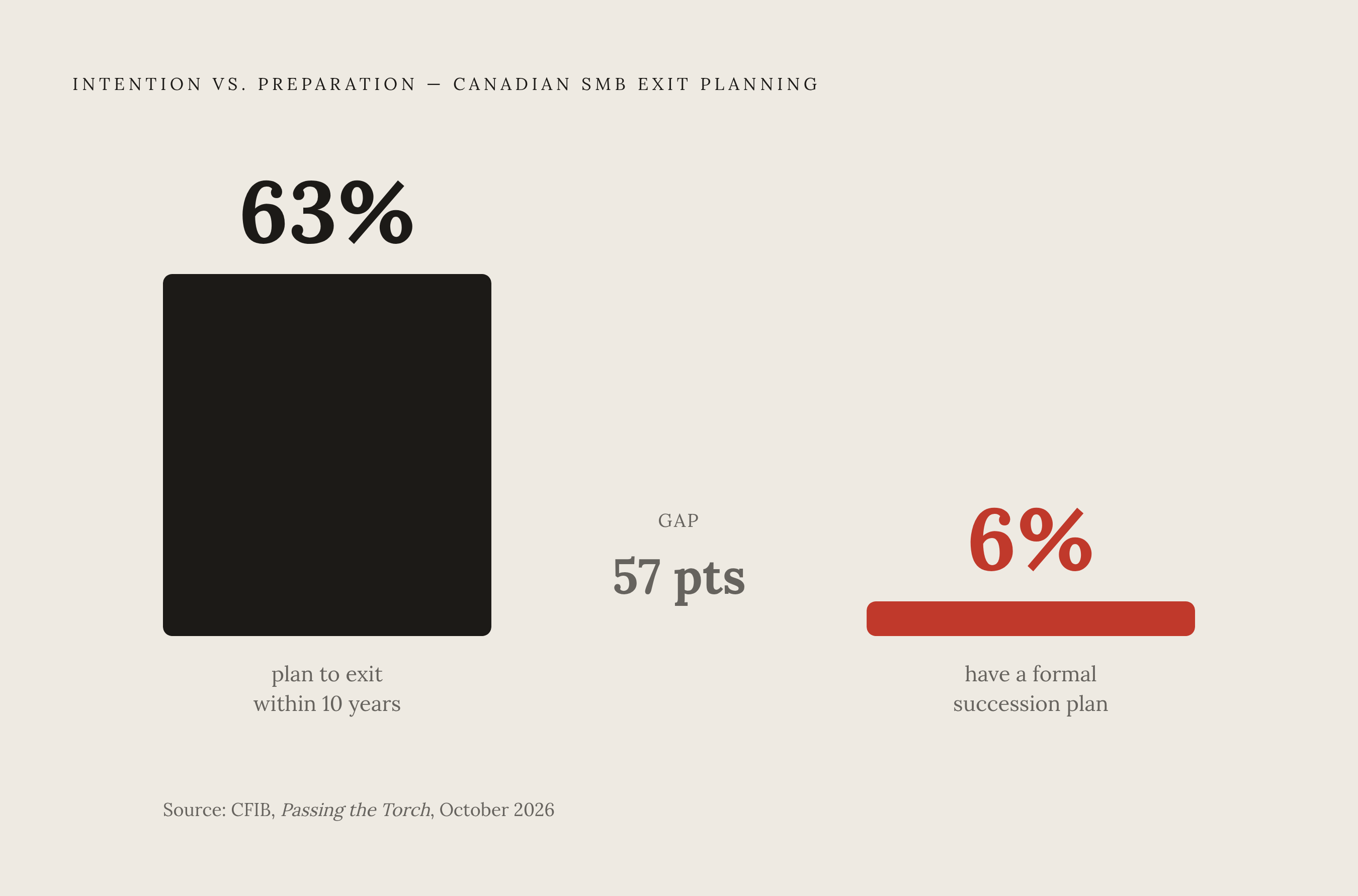
Trillions in Canadian business assets sit between owners’ intentions to leave and their readiness to do so. The Canadian Federation of Independent Business’s October 2026 report, Passing the Torch, found that 63% of owners plan to exit within the decade, while only 6% have a formal succession plan. That gap extends beyond individual retirement accounts. Business exits have outpaced new business creation in Canada since early 2024, so failed transitions occur in an economy already losing more businesses than it adds.
Why do so many owners plan to leave but do so little to get ready? The report identifies finding a buyer or successor, being too busy to plan, and difficulty determining business value as leading barriers. None describes a failure to recognize the need. Retirement drives most planned departures, but burnout and high operating costs can compress the timetable before preparation begins. The missing element is a mechanism that turns a distant intention into decisions while the owner is still occupied with running the business.
What "being too busy to plan" actually means structurally
A point-in-time valuation, an advisory meeting and a succession checklist share a hidden dependency. Each needs the owner to start the work, work out what it means and keep acting on it afterward. The owner remains the engine of the process. When running the business takes up that person’s attention, planning stops even as the business, its risks and its eventual tax position keep changing.
“Start earlier” is therefore incomplete advice. Earlier access to a passive tool does not resolve the burden of keeping a plan alive. Strategies that use the Lifetime Capital Gains Exemption, estate freezes and family trusts need work ahead of time, before a buyer appears. A valuation that describes today’s business cannot, by itself, maintain the conditions needed for those strategies.
CFIB’s report finds that owners with formal written plans are substantially more confident of a successful exit than owners without them. That association points toward the importance of a structure that persists over time. The unmet need is continuous monitoring between advisory engagements, with changes translated into decisions that deserve the owner’s and advisors’ attention.
What tool can help value a Canadian business before talking to buyers?
An agentic valuation model fills the time between advisory engagements by working with live business data as it comes in. Here, “agentic” means that the system detects changes and generates recommended actions without waiting for the owner to request another assessment. It does not mean replacing professional judgment. Its function is to bring a developing problem into the planning process while there is still time to respond.
A static report may remain unchanged while a customer takes a growing share of revenue, a key employee leaves or passive assets accumulate. An ongoing model can flag customer concentration that is compressing the multiple, a rising owner-dependence score or assets approaching a threshold that threatens Qualified Small Business Corporation status. The output goes beyond an updated value estimate. The model shows what is pulling value down and suggests how to respond.
Predictive modeling adds a time dimension by applying historical patterns to forecast where value is headed. That forecast helps an owner judge whether what they do now is likely to close or widen the gap before exit. Anomaly detection can also expose recurring “one-time” expenses and compensation add-backs that buyers may reject. Together, these functions make the tool useful before negotiations, when correcting the underlying business is still possible.
How Canadian tax law turns soft planning timelines into hard deadlines
The Lifetime Capital Gains Exemption under section 110.6 of the Income Tax Act is $1,275,000 for 2026, but access depends on conditions established before the sale. QSBC eligibility includes a 24-month holding requirement for the seller or a related person and asset-use conditions. At sale, the vast majority of the assets’ fair market value must be used in active business. A favourable valuation cannot substitute for those conditions.
Purification removes excess cash and passive investments from the operating company and typically takes 12 to 24 months. An owner who waits until deciding to sell may thus have too little time to do the work needed. Continuous asset-ratio monitoring can reveal drift before it becomes a transaction constraint. Owners need to assess both what the company is worth and whether its structure will allow them to retain the expected proceeds.
Bill C-59 intergenerational transfer rules make this distinction particularly consequential for families. Choosing an immediate or gradual transfer path depends both on when the family wants the transfer to happen and on the conditions it must meet for the intended tax treatment. A missed condition can undermine the transfer structure. CRA review windows extend for years after an immediate transfer and longer for a gradual one, so compliance does not end at closing.
Family trusts introduce another advance-planning requirement. LCGE multiplication across Canadian-resident beneficiaries can shelter a substantially larger gain, but the trust must be established and holding shares well before the sale. It cannot be created retroactively. In each case, monitoring is valuable because it connects a changing business to a deadline that a later valuation cannot repair.
How valuation method and industry sector determine whether a business is sellable at all
Before asking what multiple to use for a business, an owner needs to ask what earnings measure the buyer will use. Smaller Canadian businesses are commonly priced on Seller’s Discretionary Earnings, while larger businesses use EBITDA. These are not interchangeable valuation inputs. Applying a multiple to the wrong measure distorts the baseline before questions of quality, risk or transferability enter the discussion.
Technology and SaaS businesses attract high multiples through recurring revenue, low churn and high gross margins, but owner-dependent client relationships can compress them. Healthcare and professional services businesses face a similar distinction between transferable relationships and a practice whose value depends on the owner’s credential. Transferability is the dividing line in both cases. Attractive earnings do not necessarily describe a business that can operate under someone else.
Construction and trades make the same mechanism visible through staffing and process. Licensed employees, documented procedures and recurring commercial maintenance contracts can support a materially higher multiple than a purely owner-operated business with the same SDE. Customer concentration adds another risk across sectors because a large revenue share tied to one customer weakens the buyer’s position. These are trackable conditions, which makes valuation preparation a continuing assessment of the business rather than a search for a favourable industry multiple.
The five valuation mistakes that most reliably destroy deal value
The first mistake is using the wrong earnings metric. Applying SDE multiples to EBITDA, or EBITDA multiples to SDE, creates a structural error that flows through every later calculation. It is detectable before any buyer appears. A model’s baseline must distinguish the earnings measure from the multiple applied to it, rather than treating both as adjustable ways to reach an expected price.
The second mistake is claiming add-backs that buyers will reject. Buyers and owners often disagree during due diligence over owner compensation and expenses said to be out of the ordinary. An annual “one-time” expense reveals its own contradiction. Anomaly detection can identify that recurrence in expenses early, allowing the valuation to move from the owner’s preferred presentation to earnings a buyer is likely to accept.
The third mistake is choosing benchmarks that do not fit the business. Public-company valuations and headline strategic or private-equity deals do not translate directly to owner-operated SMEs because scale, buyer type and deal structure differ. Self-valuation without a market cross-check leaves that mismatch unchallenged. Comparable closed transactions provide a better test, while continuous market comparison can reveal when the owner’s expectations have separated from relevant evidence.
The fourth mistake is starting too late to do the work needed. A 12-month runway can foreclose purification, trust establishment and intergenerational transfer choices that needed earlier action. The error lies outside the valuation number. A model can identify that timing risk, but it cannot manufacture the missing years.
The fifth mistake is equating headline price with cash at closing. Earn-outs and seller financing can defer a substantial share of proceeds, with some payments dependent on post-close performance. Retirement plans anchored to the announced price may therefore depend on money the owner never receives. This is a separate test from enterprise value. Seeing early how estimated worth differs from cash at closing lets the owner and advisors plan around both the business’s value and the money the owner will have for the next stage.
What the planning timeline actually requires, year by year
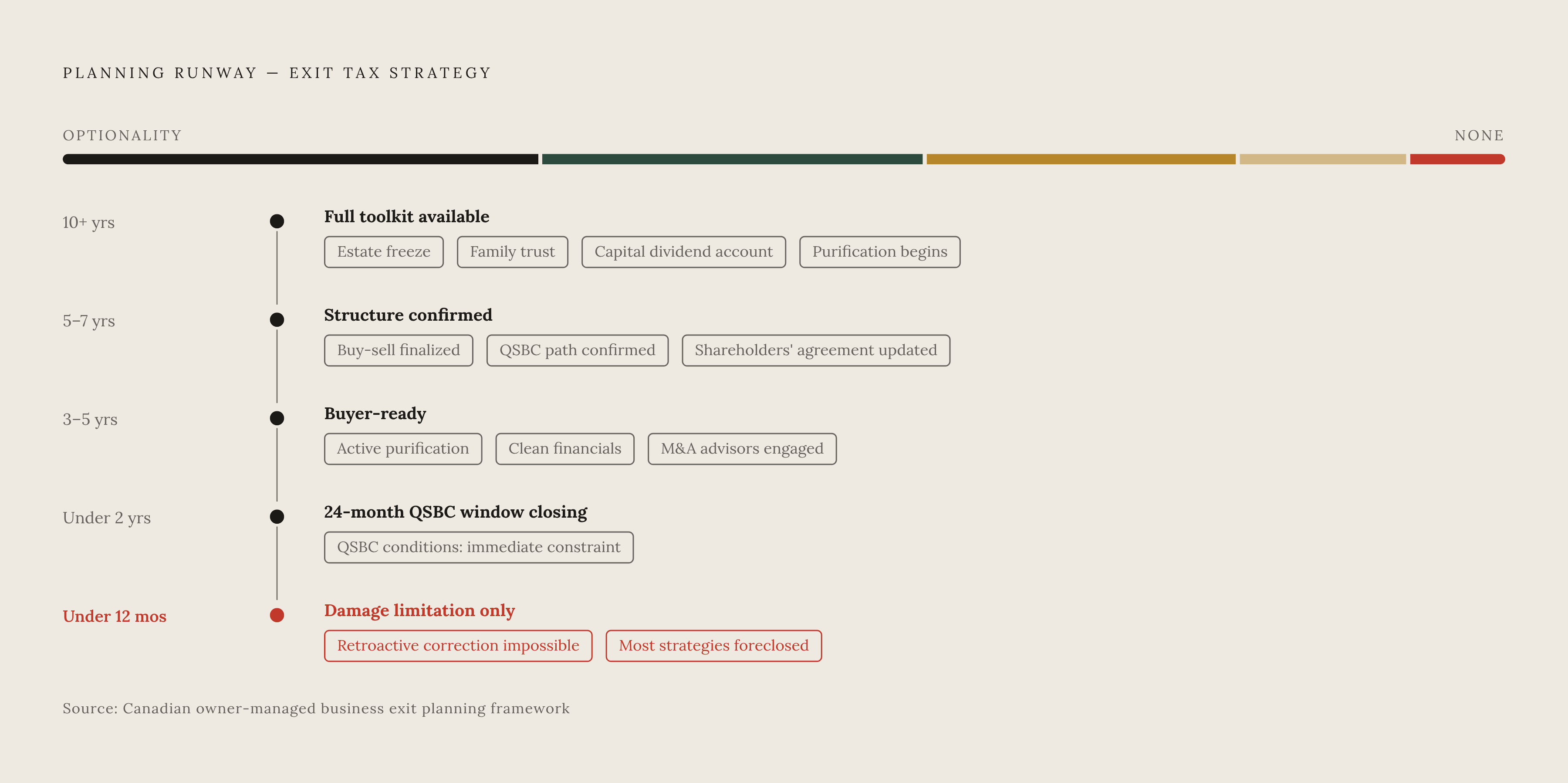
Ten or more years before exit, a full-optioned plan can begin with an estate freeze, family trust establishment and insurance funding. The capital dividend account position can start building, while purification of passive assets from the operating company begins. These steps create room for later choices. A continuously running model is useful over this period because changes in the business can alter the assumptions on which the original plan depended.
Five to seven years before exit, the work moves toward formal commitments. The buy-sell agreement is finalized, the QSBC path is confirmed and the shareholders’ agreement is updated to reflect succession intent. Governance begins to catch up with intention. Keeping track of the business at this stage helps keep those agreements in step with how it is being run.
Three to five years before exit, preparation becomes more directly visible to a buyer. Active purification continues, financial reporting is tightened to buyer-ready standards, M&A advisors become involved and buyer matching begins. Most owners enter planning within this window. It remains workable, but the remaining steps need to proceed without delay because tax preparation and business improvements compete for the same shrinking runway.
Under two years, the 24-month requirements become an immediate planning constraint. If the necessary historical conditions are absent, they cannot be created retroactively for the intended sale date. Inside 12 months, the model’s work shifts more and more from making things better to limiting the damage. For an owner in that position, an up-to-date estimate still helps show what the business is worth and where negotiations could go wrong, but it cannot bring back every tax option. The benefit of starting earlier lies in how many decisions remain available when the system identifies a problem.
What happens to the business — and the family — when no plan ever runs
CFIB’s report finds that one in eight owners expects to close rather than sell, with a higher share among retailers. Those closures remove jobs, local services and community economic activity. The consequences extend beyond the departing owner. Family-owned enterprises employ nearly half of private-sector workers and generate close to half of private-sector GDP, making continuity an economic concern as well as a household one.
Within a family, an absent plan also leaves authority unresolved. Without written rules for governance, economic rights for family shareholders and ways to prepare successors, the next generation may be unsure how they will be paid and who gets to make decisions. If death or incapacity intervenes first, default tax and estate rules determine consequences that the owner never deliberately chose, after the opportunity to prepare has passed.
Demographics narrow the remaining room for delay. ISED and Statistics Canada’s 2023 SME ownership findings show that a majority of owners are past 50. Yet an agentic model does not guarantee a buyer or a successful transfer. Its contribution is to keep valuation, readiness and deadlines visible while the owner continues operating the business. With help from experts, AI-driven buyer matching and investment banking advisory can help owners use that preparation to reach qualified buyers.
The practical case for running the system is affirmative. It gives the owner a continuing view of what can transfer, what needs correction and which decisions still have time to work. The owner with a system acting on their behalf can respond while choices remain open, rather than waiting for the day when there is finally time to plan.