Tuck-In vs Bolt-On Acquisition Differences for Seller Positioning
Understanding whether you're a tuck-in or bolt-on determines your sale price and post-close fate.
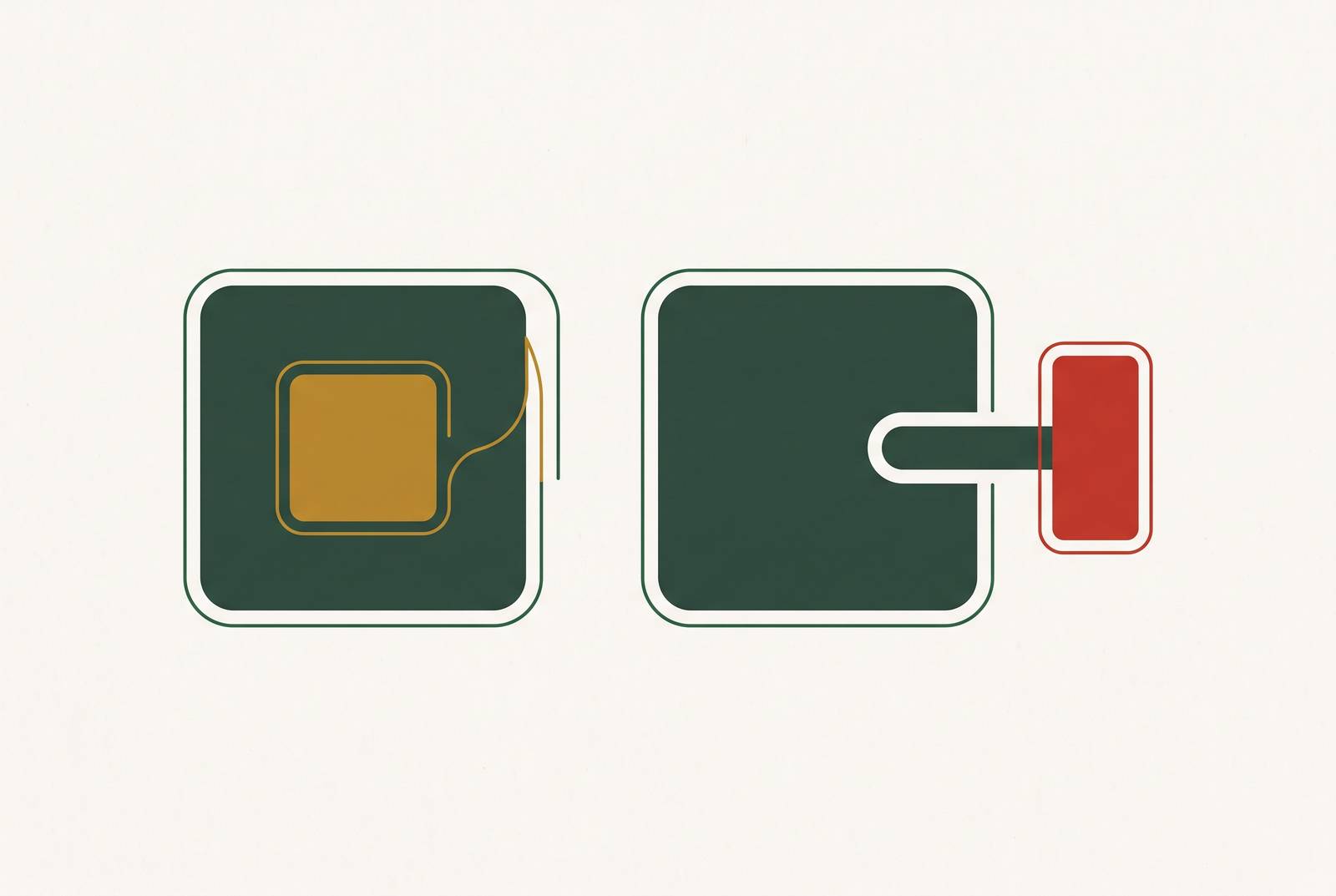
A tuck-in and a bolt-on are not two different kinds of deal, they are two points on the same spectrum of how much of a company survives its own acquisition. This piece exists to show sellers why that distinction, more than any other piece of M&A vocabulary, determines the price they receive and the terms they live with after close.
Why the tuck-in / bolt-on distinction exists
"Add-on" is the umbrella term for any company a PE-backed platform buys after its first deal, the original "platform" acquisition that gave the private equity firm its foothold in a sector. Tuck-in and bolt-on sit underneath that umbrella and describe how deeply the acquired company gets absorbed into the platform that bought it. A tuck-in means full absorption. The acquired company's systems, its brand, its standalone identity, all of it disappears into the platform's existing operations. The acquirer does not build a new division or carve out a semi-independent unit. It simply folds the target into what already runs, and the clearest signal that a deal is heading toward tuck-in treatment is size: tuck-ins tend to be very small relative to the acquirer, small enough that absorbing them requires no new infrastructure.
A bolt-on sits further along the spectrum, closer to independence. The target still gets integrated, selectively, into the platform's resources and reporting lines, but it retains more of its own shape. The business keeps enough of its own identity that a customer might not notice right away that ownership changed hands.
| | Tuck-in | Bolt-on | |---|---|---| | Integration depth | Full, systems and brand absorbed | Selective, platform resources shared | | Relative size | Small relative to acquirer | Larger, more strategically distinct | | Brand | Retired | Often retained | | Management | Frequently departs | Frequently stays | | Standalone identity post-close | Ceases to exist | Survives in meaningful form |
In practice, buyers and even advisors use the two terms interchangeably, and that looseness is part of why sellers misjudge their own position before a conversation even starts. A founder who hears "add-on" and assumes it means the same thing regardless of who is calling has already given up the one piece of information that matters most: how much of what they built will still exist in six months. That is the question this entire piece is organized around, because the label a buyer applies, tuck-in or bolt-on, carries different economic consequences and different operational consequences, and a seller who cannot tell the two apart cannot negotiate either one.
Why PE-backed platforms run the add-on playbook so aggressively
Platforms buy add-ons because acquiring growth is faster and cheaper than building it. The aggression is driven by arithmetic, not ambition.
Add-ons are typically purchased at a lower multiple than the platform itself trades at. Once the add-on is folded into the platform's financials, the combined entity is worth more, on paper, than the sum of what was paid for its parts, even before a single operational synergy gets realized. This is multiple arbitrage, and it is the reason financial buyers, private equity firms running a roll-up strategy, pursue this playbook far more aggressively than strategic buyers do. A strategic acquirer buys a company because it wants that company's capability or market position. A PE-backed platform buys a company partly because the math rewards the platform's eventual exit valuation directly, regardless of how much operational value gets created along the way.
Tuck-ins fit this logic especially well because they require so little integration effort. A platform pursuing tuck-ins is usually after customers, a specific capability, a team, or raw capacity, and because the absorption is mechanical rather than strategic, the platform can execute the same playbook repeatedly across a sector without reinventing its process each time. That repeatability is what allows some platforms to close a dozen add-ons in a single year.
One qualifier matters here. A platform with weak underlying fundamentals, one that is buying growth because it cannot generate it internally, introduces integration risk and earnout risk that compounds whatever exposure the seller already carries. A seller evaluating an offer should ask not just what multiple is on the table, but whether the platform behind it is actually healthy.
How integration depth changes what each buyer type values
Because tuck-ins and bolt-ons serve different purposes for the buyer, they prize different things in the business being bought. A tuck-in buyer is primarily acquiring revenue, customers, or capacity. Not strategic architecture. The buyer already has those things. It needs volume.
A bolt-on buyer is after something structurally different: a technology stack it cannot build in-house on a reasonable timeline, a licensed capability, a new geography that comes with its own embedded management team, or a service line the platform cannot easily replicate internally.
What each buyer values creates the valuation gap between tuck-ins and bolt-ons, and that gap is also the lever a seller can pull. A business generating revenue in a line of work the platform could absorb from a dozen other targets is going to be priced like a tuck-in no matter how the founder frames the pitch. But a seller who can credibly point to a proprietary capability, an embedded geography the platform has no presence in, or a management bench the platform actually needs, is positioning as a bolt-on asset even if the revenue size alone would ordinarily put them in tuck-in territory.
It is worth considering why some tuck-ins happen at all if the target brings so little strategic weight. That tells a seller something important about how the buyer will price the deal: the buyer is paying for ease of absorption, not for the scarcity of what is being absorbed. You could argue that's a reasonable trade for a founder who wants speed. That trade caps the price, because the classification itself, decided largely by what the business brings versus what the platform already has, shapes the multiple before the negotiation even opens.
How the tuck-in or bolt-on label affects price
The classification a seller ends up with materially affects the multiple on offer, because tuck-in pricing reflects the platform's arbitrage math, not the seller's standalone worth. A seller in a tuck-in deal is funding the platform's arbitrage spread, not sharing in it. The platform needs to buy low enough that the gap between entry multiple and platform multiple is wide enough to matter at exit, and that constraint sets a ceiling on what the tuck-in target can be paid, regardless of how well the business performs on its own.
Tuck-in targets tend to be at the lower end of multiples within a roll-up strategy, a function of their small size and their limited standalone value to anyone other than the platform absorbing them. Bolt-on multiples run higher because the platform is paying to close a gap it cannot replicate on its own, not because the business is worth more in isolation. A bolt-on multiple is not some abstract measure of what the business is worth in isolation. It reflects what a platform can justify paying when the target fills a gap the platform cannot easily replicate on its own, a market it lacks, a capability it needs, a geography it has no foothold in. When that gap is real and specific, the platform pays up to close it.
Competition changes this calculus directly. When multiple PE-backed platforms are chasing the same target, the discount between platform-level pricing and add-on pricing narrows, and in a genuinely competitive process it can shrink to nothing. A seller negotiating with a single interested platform has no mechanism to force that narrowing. A seller with two or three platforms bidding does.
The headline multiple is not the only thing that shifts with classification. Employment agreements and governance rights, how much say the founder retains over decisions after close, shift the same way. None of these terms are fixed by the size of the business alone. They move with how the buyer classifies the deal.
Post-close life for the founder under each deal type
Price is only half of what a founder is negotiating, whether they realize it or not. What life looks like after the papers are signed looks very different depending on which side of the spectrum the deal falls on.
In a tuck-in, the founder should expect real integration. Systems migrate onto the platform's infrastructure. What was a distinct, recognizable business before the sale ceases to exist as its own entity after it, and the founder's former employees become the platform's employees in every functional sense.
A bolt-on produces a different outcome for the people involved. The founder's leadership structure and the company's public identity survive integration to a meaningful degree, even if back-end functions like finance or compliance still get folded into the platform's systems.
That isn't a universal trade-off in the founder's favor, though. Tuck-ins tend to move faster and with less disruption during the transaction itself, because the deal needs less due diligence and a shorter integration plan than a bolt-on does. For a founder who wants to exit cleanly and quickly, without spending the next eighteen months managing a complicated transition, that speed is a real advantage, not a consolation prize.
The practical upshot: understanding which kind of post-close reality a deal implies lets a founder negotiate the specific protections that matter to them, retention packages for key employees, brand commitments written into the purchase agreement, or an employment contract that guarantees a defined role rather than a vague promise of continued involvement. None of that gets negotiated well if the founder does not first understand what kind of deal they are actually in.
Using this distinction to position a business for better terms
Classification is not handed down by revenue size alone; a seller can shape it by surfacing the attributes a bolt-on buyer is specifically looking for, even when the business, on paper, looks like a tuck-in candidate.
The first lever is articulating a genuine capability gap. A proprietary process, a licensed service, an embedded geographic presence the platform does not already have and cannot easily replicate, any of these can shift a buyer's framing from "small company to absorb" to "strategic asset to acquire." The case has to be specific. A vague claim of differentiation does not move a sophisticated buyer, but a concrete gap the platform cannot fill internally does.
The second lever is management depth. A team capable of running the business independently, without the founder at the center of every decision, signals to a buyer that they are not absorbing a leadership vacuum. That matters because a platform weighing a bolt-on is implicitly asking whether it needs to install its own management to keep the business functioning, and a founder who can answer that question before it is asked has already strengthened their position.
The third lever is brand equity. Customer loyalty tied to a name the platform would risk damaging by retiring it is an asset, not a liability to be absorbed and forgotten. Framing the brand this way reframes the entire conversation: instead of the founder asking the buyer to preserve something sentimental, the founder is showing the buyer a retention risk they would create by erasing it.
Understanding what a buyer actually values in a tuck-in versus a bolt-on is the foundation all of this rests on, and it is why some founders turn to tools built specifically to map a business's attributes against buyer priorities before the first conversation happens.
None of these levers matter if the founder treats the first PE-backed caller as the only option. That is the single biggest positioning mistake a seller can make. Competition is what narrows the discount between tuck-in and bolt-on pricing, sometimes eliminating it outright, and a founder who positions well but talks to only one buyer has built an argument with no one to make it to.
Why the right buyer matters more than the terminology
Whether a tuck-in or bolt-on classification becomes leverage depends on having more than one buyer to weigh it against. In a negotiation with a single interested platform, the distinction is interesting but inert: there is no second offer to compare terms against, no competing classification to argue for a better multiple. The vocabulary becomes practical the moment a seller has options, and theoretical the moment they do not.
What actually produces better outcomes is a process built to surface multiple qualified platforms at once, diagnose the specific gap each one is trying to fill, and position the business against that gap deliberately rather than reactively. That requires two different kinds of work. One is analytical: figuring out which platforms are actively consolidating the seller's sector and what each one is missing. The other is procedural: running those conversations in parallel, not serially, so that interest from one buyer can inform, and pressure, the terms offered by another.
Because tuck-in and bolt-on multiples can differ meaningfully, a founder's ability to credibly argue for bolt-on treatment, or to recognize honestly that their business is a genuine tuck-in and price accordingly, has a direct effect on deal economics. Getting that assessment right at the outset, informed by analysis of comparable deals and how buyers have actually behaved in them, is what keeps a founder from anchoring to the wrong multiple before negotiations even begin. The terminology matters because it describes something real about how a business will be valued and treated after close. But the terminology only pays off for a founder who has built a process capable of putting it to work.