Information Barriers and Staged Disclosure Protocols That Shield Canadian Sellers From Internal and Competitive Exposure
A staged, clean-team process lets rivals evaluate a deal without taking your secrets.
A confidential business sale process for Canadian SMBs can find qualified buyers without a public listing by combining a vetted buyer network with staged disclosure. The central protection is sequencing. Anonymous outreach, buyer qualification, contractual restrictions and controlled diligence let serious buyers evaluate the business without giving unsuccessful bidders unrestricted access to its customers, pricing and operations.
Why selling a Canadian business — especially to a competitor — creates a unique information-exposure problem
A competitor may be the buyer best placed to recognize a business’s value. It understands the industry and may see synergies that support a premium. Yet the diligence needed to assess those opportunities also reveals customer relationships, supplier terms, margins and employee compensation. The buyer’s commercial insight cuts both ways. If negotiations fail, it returns to competing with knowledge it did not have before.
Pitblado Law identifies the central question as “what happens if the transaction does not close?” Even when a contract bans the use of that information, it is hard to stop what the buyer knows from shaping later decisions. Canada’s Competition Act adds a separate concern because sharing competitively sensitive information can raise legal issues even when the acquisition talks are legitimate. Exposure also extends beyond the rival’s deal team. SeaRidge Advisory identifies staff uncertainty, customer concern and competitor opportunism as distinct risks when news escapes before a transaction is ready.
What staged disclosure actually is — the architecture of a controlled information funnel
Staged disclosure makes access conditional on a buyer’s progress and commitment. Each release serves the next decision. The structure must protect the seller from premature exposure while giving a serious buyer enough information to proceed. Those goals are compatible only when the process distinguishes what a buyer needs now from what it may need eventually.
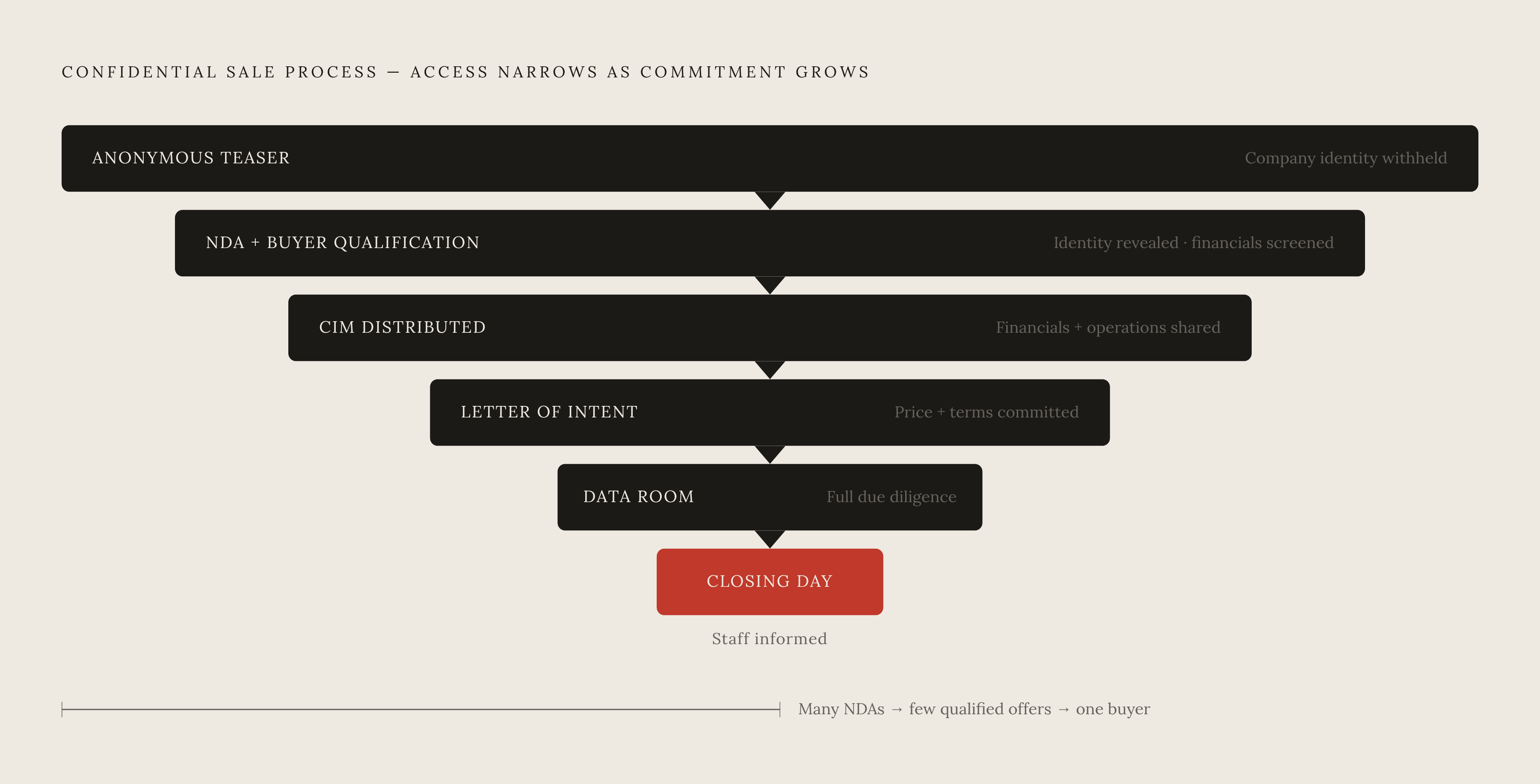
The sequence begins with an anonymous teaser, followed by a signed NDA and buyer qualification. A confidential information memorandum then supports evaluation before a letter of intent establishes the basis for full diligence. The controlled data room comes next, and employees as a whole are told on closing day. Many signed NDAs may therefore produce only a handful of qualified offers. The narrowing funnel is deliberate, and the controls also help preserve the protected legal status of the information being sold.
Stage one — the blind teaser and how to write one that is genuinely blind
Main Street Exit Partners describes a confidential property summary that omitted the name and address but included building size, year built and general location. Public property records made it identifiable in minutes. An omitted name was not enough protection. The same problem arises when a business teaser combines otherwise ordinary details into a recognizable profile.
The practical test is to read the teaser as a competitor would. Describe the industry broadly enough to include many companies, use a broad geographic region and express revenue and earnings as ranges. General growth history and a business-model description can help attract suitable buyers. Exclude company and owner names, specific location, customer names, employee count and operationally unique details.
Distribution requires equal care, because anonymity does not justify indiscriminate outreach. Recipients should have demonstrated acquisition capacity and a strategic rationale. The usual audience is financial sponsors that focus on the sector, strategic buyers in nearby markets and family offices. Direct competitors require a separate decision from the seller. The seller should clearly approve each contact before anyone reaches out.
Stage two — what the NDA must actually do, and what it cannot
The NDA governs the transition from anonymous interest to identified evaluation. A buyer’s standard form may favour its own interests, so the seller’s counsel should review or redraft it. The agreement should define permitted recipients and restrict use to evaluating the specific transaction. It should prohibit unauthorized contact with employees, customers, suppliers and the landlord. Employee non-solicitation for a defined period and return or destruction of materials when talks end also belong in its scope.
Storage and processing restrictions deserve explicit attention as well. Main Street Exit Partners flags limits on pasting confidential content into public AI tools. These restrictions address where information goes after disclosure. Pitblado says diligence procedures and the NDA should address access, purpose, disclosure restrictions and what happens when negotiations end.
A signature alone does not qualify a buyer. Financial capacity and signs of information fishing must be assessed before the confidential information memorandum, or CIM, is released. That document names the company and presents its financials, business description and value drivers, making the exposure substantially greater than a teaser creates. SeaRidge treats qualification and the signed NDA as joint prerequisites. Even then, the contract remains one part of the system because enforcement cannot undo a careless disclosure.
Clean teams and Canada’s Competition Act — the extra layer required when the buyer is a rival
For a direct competitor, some information should remain outside the buyer’s commercial organization entirely. Pitblado describes a clean team of external advisers or appropriately segregated individuals who do not make the purchaser’s day-to-day competitive decisions. This creates a barrier within the diligence process. A small named group may include outside counsel, economists or consultants, and occasionally an in-house person without a commercial role.
The clean team can review customer-level economics, pricing, the cost stack and forward strategy. It then passes approved aggregated or anonymized findings to the deal team without exposing the underlying files to commercial staff. A buyer can receive findings needed for its decision without giving its sales personnel the raw customer-pricing data.
Pitblado notes that acquisitions of any size, including those below the monetary thresholds for advance notification, remain subject to Competition Bureau review. Sellers should raise it early to understand whether review could affect closing likelihood or timing. The smallest possible clean team helps guard against “gun-jumping,” meaning unlawful pre-merger coordination or premature integration before closing. Stronger employee non-solicitation provisions and tighter customer-contact restrictions support that structural separation.
Tiered data room controls — how permission, staging, watermarking, and redaction work together
A data room turns disclosure decisions into enforceable access boundaries within the diligence process. Permission by group separates roles rather than assuming everyone on the buyer’s side needs the same documents. Lawyers may need to see contracts with customer-level pricing left out. The clean team may need raw financial material that commercial personnel cannot see. Access follows the task.
Staged folders add a second boundary based on commitment. The letter of intent, or LOI, is the gate to full diligence, with restrictions continuing to apply. Sensitive material including customer names, individual salaries, product-line margins and unremediated security findings should be held back at the CIM stage for release after that gate. Watermarking shows who received each page by putting that person’s identity on it. Redaction removes details that would create more risk if shared early than is needed to assess the business.
View-only files and document-level access logs make diligence traceable, while redaction can still protect information within an authorized folder. Before an LOI, disclosure centres on financial and business information needed to support an offer, without facility visits, customer introductions or employee contact. Customer names and payroll by person remain among the last releases. Even after an LOI, the owner’s explicit approval governs those steps because commitment to price and terms does not erase competitive risk.
Managing internal exposure — keeping employees, advisors, and key-person disclosures in sequence
Work to prepare for a sale can give it away before anyone reaches out to buyers. When staff are asked for an unusual mix of financial records, contracts and employee data, they may realize something has changed. Trust does not eliminate that risk. Disclosure should be limited to those who genuinely need to know now, since premature disclosure can prompt departures, demands for guarantees or conversations with customers. Staff helping compile records should receive truthful, need-to-know explanations coordinated with counsel and the advisor.
Some early disclosures are necessary to preserve value. Would the buyer’s price or the lender’s approval change if a particular person left? If so, the owner should plan the timing of that conversation, usually after an LOI, to pre-empt rumour. Main Street Exit Partners describes a Greater Cincinnati distributor that was sold to an employee and whose owner told a manager who was key to revenue early in the process. The manager helped the sale proceed, and the buyer needed confidence that the person would stay.
The bookkeeper may also need early involvement because financial requests run through that role. Broader staff disclosure follows a different timetable. Near the end, customer and key-supplier conversations require the owner’s explicit approval, while change-of-control clauses may require customer consent. Independent confirmation letters or surveys can sometimes verify customers without telling them directly. The sequence depends on what diligence genuinely requires.
Site visits and competitive buyers — physical access as the highest-risk disclosure moment
A site visit exposes what documents can conceal or redact. It is the highest-risk moment for internal confidentiality because staff can see the buyer and the buyer can observe operations directly. SeaRidge recommends off-hours visits where possible, truthful and limited descriptions to staff, and advance agreement on the visit protocol. Buyers should not approach employees, customers or suppliers without the seller’s and advisor’s authorization.
For competitors, physical access must respect the same separation as document access. Commercial staff barred from customer-pricing files should not learn the same details by walking the floor and watching how the business deals with customers, how it is staffed or how much capacity it has. The medium changes, but the risk remains. Main Street Exit Partners recommends limiting who can see customer pricing, product margins and the identities of key people until the deal is close to final. Visit boundaries must account for what participants can observe and ask.
What breaks down when the process is not structured — and what to do if a deal falls apart
An unsuccessful bidder cannot be made to forget what it learned. A rival that has seen customer lists, margins and compensation may remember details that help it make later bids or decide whom to recruit, even when it is banned from using them. Pitblado distinguishes that practical enforcement problem from the contractual restriction itself. A poorly controlled process can also undermine the protected status of the information.
When negotiations end, the NDA’s return-or-destruction provisions become operative. Their usefulness depends on drafting done before the documents were shared, while staged access determines how much information was exposed at all. Failed-deal planning belongs at the beginning of a sale so the seller can protect customer names and individual pricing by withholding them until a buyer progresses far enough to need them.
How do you find an advisor to sell your Canadian business privately?
An advisor for a private Canadian business sale should build the protocol before the first teaser leaves the seller’s control. The relevant criteria are concrete. They include a network of buyers who have been pre-screened, checks that buyers can pay before they receive the CIM, clear tiers for what information is shared and ties to counsel who can set up clean-team arrangements for Canadian transactions. Neither replaces coordination among the owner, advisor and legal counsel.
Canadian founder-led businesses that have optimized for tax minimization rather than investor readiness may need normalized financials and organized documentation before buyer engagement. This work supports an accurate data room. It also gives the advisor a defined body of information to release in sequence rather than assembling the process around incoming requests.
AI-driven buyer matching combined with experienced investment banking advisory can widen the search to qualified buyers a founder would not find independently. Its value here depends on screening for capacity and strategic fit before sensitive disclosure. A sale run by professionals should aim for the highest value and a better chance of closing while keeping the owner in control of who gets access. Finding a buyer should not require handing a competitor the keys before the deal closes.