Exclusivity Window Length Trends in Canadian Lower Middle Market M&A
Deals now take three to four months, not the traditional 45-60 day standard.

An exclusivity clause binds a seller to negotiate with a single buyer for a set period, and its length determines how long that seller stays out of the market while everyone else moves on without them. It is the no-shop provision: the seller agrees to suspend conversations with any other party for the duration of the window, full stop on competing term sheets, full stop on backup offers. What makes this clause different from almost everything else in a letter of intent is enforceability. Most of an LOI is aspirational: it is a statement of intent, not a contract, so price, structure and terms typically stay non-binding until you sign a definitive purchase agreement. Exclusivity is usually the one provision that binds immediately, making its duration a genuine point of negotiation rather than a formality to skim past on the way to the valuation section. Every day inside that window is a day when the seller cannot test the market, field a competing call, or restart a process if the buyer's enthusiasm cools. In the Canadian lower middle market, the segment where most owner-operated companies change hands, that window has traditionally run several weeks, calibrated to give a buyer time to complete confirmatory diligence and draft a definitive agreement.
The 45–60 day benchmark no longer matches how long deals take
Cassels' Private Equity team ran an internal survey of legal trends across the first two quarters of 2025, and the finding should recalibrate how sellers think about exclusivity before they sign anything. Most respondents said diligence periods were taking longer than usual: the typical period between LOI signature and closing now runs three to four months, against the traditional benchmark of 30 to 60 days. That roughly doubles the time a seller might expect to spend locked out of the market relative to what the conventional window was built to cover. The shape of a full deal process explains where that extra time goes: a marketing phase running from CIM distribution through IOI collection typically takes 8 to 12 weeks, LOI negotiation itself runs another 2 to 4 weeks, confirmatory diligence after exclusivity is granted commonly takes 6 to 10 weeks, and purchase agreement negotiation plus closing mechanics adds a further 2 to 4 weeks. Those stages together make a three-to-four-month LOI-to-close window commonly reported as normal in this segment, not an outlier case or a sign that something went wrong. A seller might reasonably object that clean businesses still close fast, and they do, if the transaction is very small or exceptionally simple. But it describes a shrinking share of what actually trades in the Canadian lower middle market, where multi-entity consolidations, earnout negotiations, and lender diligence are routine features of a deal, not complications bolted onto an otherwise simple sale. The conventional 45 to 60 day exclusivity benchmark was built for a shorter process. The process has moved on without it.
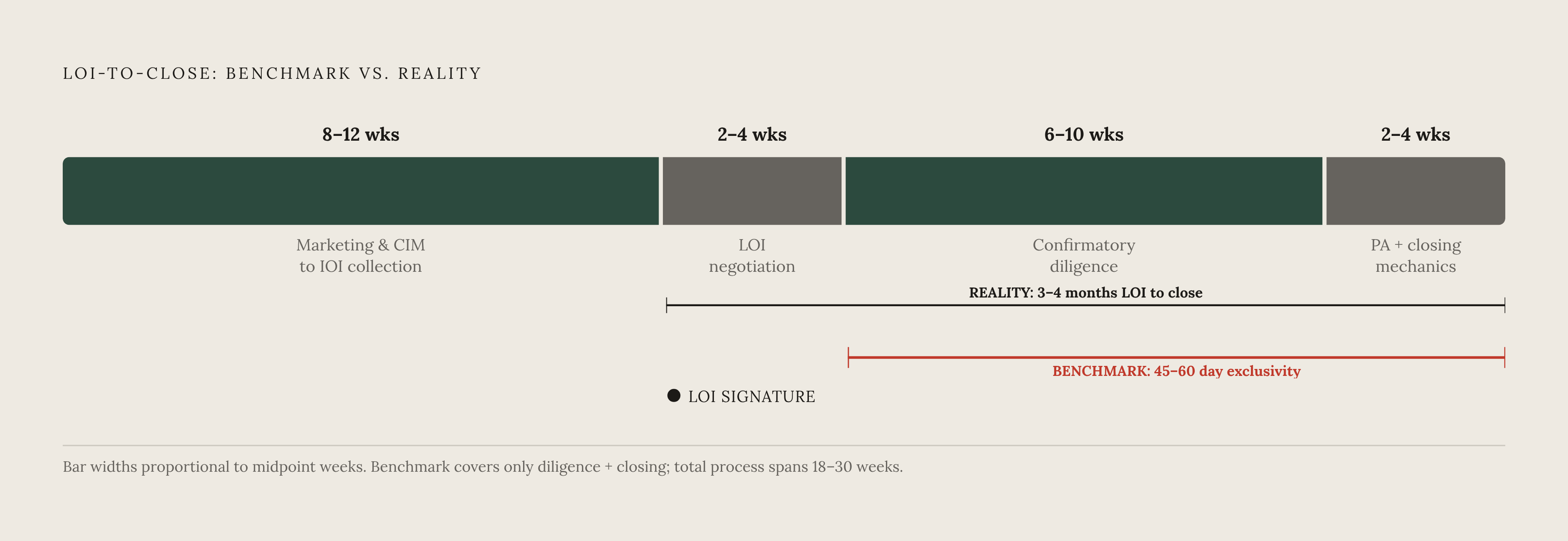
Three structural forces pushing windows longer
What explains the gap between the old benchmark and what Cassels is now reporting? Three structural changes are driving it, and none of them look like a cyclical backlog that will clear once deal volume normalizes.
The first is expanded diligence scope. Quality of Earnings reviews are now standard practice in this segment, and a lower-middle-market QoE commonly runs several weeks on its own, longer still when inventory accounting, percentage-of-completion revenue recognition, or multi-entity consolidation is involved. The timing trap here is subtle but consequential: the diligence clock effectively starts when the data room is actually populated, not when the LOI is signed. If a seller is slow assembling financial records, contracts, and corporate documents, exclusivity time burns before diligence has meaningfully begun, and that time rarely comes back. Lender diligence, HR review, environmental assessment, and commercial diligence now tend to run in parallel rather than one after another, which sounds like it should compress timelines. In practice, each stream generates its own information requests, and each request restarts a sub-clock within the broader window.
The second force is specific to Canada, and it deserves more attention than it typically gets from founders who assume the regulatory backdrop is static. The Investment Canada Act was significantly amended in 2024 and 2025, and national security review now extends to minority stakes and asset purchases, not only full acquisitions as under the prior framework. For deals touching prescribed business activities, including sensitive technologies, critical minerals, or personal data infrastructure, mandatory pre-closing filing requirements introduce review periods that sit entirely outside a buyer's or seller's control. The Competition Bureau adds another layer on top of that: the Bureau retains a window to challenge a transaction for substantially lessening competition even when the deal falls below the formal notification threshold that would otherwise trigger mandatory review. So if a sector is affected, an exclusivity window sized to the old 45-to-60-day benchmark can expire before the regulatory process resolves anything, and buyer and seller end up in a gap neither the LOI nor the deal timeline planned for.
The third force is less obvious because it looks, on the surface, like good seller behavior. Sellers increasingly run broader auction processes before they grant exclusivity, so the timeline from first outreach to signed LOI lengthens, but they do it to build leverage once exclusivity begins. Portage M&A's 2026 Canadian LMM outlook notes that the buyers most active in this segment (private equity firms, family offices, and well-capitalized individuals) bring real experience, capital, and internal resources to evaluating and integrating owner-operated businesses, paired with a demand for a thorough process. You might think a tighter competitive process before LOI would translate into a shorter window after it. The data shows that sellers who run the most competitive pre-LOI process often end up selecting the buyer with the most rigorous post-LOI requirements, typically a PE firm, and that selection extends the diligence clock.
These three forces do not operate independently. If a private equity buyer needs investment committee approval, operates in a sector that touches sensitive technology under heightened regulatory review, and acquires a business with multi-entity consolidation and complex revenue recognition, it will routinely need several months to close, even when the seller cooperates fully and the data room is populated on day one.
How buyer type reshapes a "normal" window
The appropriate length for an exclusivity window depends heavily on who is sitting across the table, and treating 45 to 60 days as a universal market norm costs sellers negotiating leverage they didn't know they had. Strategic acquirers tend to accept shorter windows, largely because their diligence is often narrower in scope: it focuses on operational and commercial fit, not the layered financial, legal and investment-committee review a financial sponsor requires. Private equity firms typically need 60 to 90 days to fit in full diligence alongside internal investment committee approval, and some larger mandates push well past that range. Family offices tend to land somewhere in the middle, but the range varies a lot: it depends on whether a given office has in-house diligence capability or relies on outside advisors for work a PE firm might staff internally.
Portage's 2026 Canadian LMM outlook confirms that PE firms and family offices are the most active buyer types in this segment. That means the buyer type most likely to ask for the longest exclusivity window is also the buyer type a Canadian lower-middle-market seller is statistically most likely to face. Sellers who benchmark their expectations against strategic buyers, long treated as the reference point for deal norms, are often anchoring to a buyer profile that no longer represents who makes most of the offers in this market. If you know which buyer type is proposing the window, you gain more than you would from the generic market average, because that average blends buyer types whose diligence needs differ fundamentally in scope and duration.
Longer windows, re-trade risk, and contingent consideration
A longer exclusivity window does more than inconvenience a seller's calendar. It changes the balance of leverage inside the deal itself. The mechanics are straightforward: the longer exclusivity runs, the more time a buyer has to surface diligence findings, real or inflated, and use them to push the headline price down before signing. That leverage compounds, because the longer the seller stays with one buyer, the more it costs to walk away and restart a competitive process.
That dynamic is landing at the same moment contingent consideration is becoming more common in the lower middle market. Earnouts defer part of the purchase price based on the business's performance after closing, and they are rising as a structural feature of LMM deals, a pattern documented across the segment. An earnout asks a seller to accept that part of their payout depends on results they no longer fully control once ownership has transferred. A seller who grants a long, unconditional exclusivity window and then also accepts an earnout has effectively shifted risk toward themselves twice in the same transaction: once during diligence, when a drawn-out window gives the buyer room to chip at price, and again after closing, when deferred consideration depends on performance under new ownership.
PwC's 2026 Canadian M&A outlook anticipates that increased scrutiny and deeper due diligence, combined with negotiations around pricing mechanisms such as earnouts and flexible consideration structures, will keep extending deal timelines. That observation points to something sellers should sit with carefully: the same conditions producing longer exclusivity windows are producing more contingent deal structures. Aethlon's 2026 LMM trends note adds a market-level confirmation, observing that multiples have stayed flat while escrows and earnouts have risen. You can see the risk-shifting pattern connecting window length to contingent consideration in deals happening now, not as a theoretical concern for sellers to file away.
The 2024-2025 Canadian tax policy whiplash and exclusivity timing
Even sellers who understood the conventional exclusivity playbook were operating against a distorted backdrop over the past two years, because Canadian tax policy moved in ways that scrambled the orderly staging a well-run exit process depends on. The 2024 federal budget proposed raising the capital gains inclusion rate substantially, to two-thirds from one-half for corporations and trusts, and to two-thirds on the portion of individual gains exceeding $250,000 in a year. So founders faced immediate pressure to accelerate their exit timelines ahead of the deadline, and that pressure shaped decisions made under exclusivity clauses signed in haste. The government then deferred the increase on January 31, 2025, and fully cancelled it on March 21, 2025, reversing the urgency that had pushed some founders to grant exclusivity on unfavorable terms specifically to beat a deadline that ultimately never arrived. A related proposal, the Canadian Entrepreneurs' Incentive, which would have offered a reduced inclusion rate on a capped amount of lifetime eligible gains, was itself cancelled on November 4, 2025, removing a tax benefit that some founders had already factored into their exit math.
The combined effect reaches directly into exclusivity negotiations. Founders who timed their LOI around the original capital gains deadline may have granted exclusivity under real time pressure, with less competitive tension in the process than a properly staged sale would have generated. Other founders delayed their processes altogether while waiting for policy clarity, and that disrupted the orderly pre-LOI staging that lets a seller enter exclusivity from a position of strength, with multiple interested parties already engaged and warmed up. Either distortion, rushing or delaying, means a seller enters the exclusivity window with less leverage than a calmly planned process would have secured: fewer alternative buyers in reserve, less standing to push back on the length of the window itself.
What sellers should negotiate before they grant exclusivity
If you understand why windows are stretching, you can negotiate the length and structure of exclusivity instead of simply accepting the buyer's opening number.
On duration, buyers typically open at 60 to 90 days, and sellers should treat that as a starting point for negotiation rather than a market given, countering with a shorter initial lockup period. A base-period-plus-extension structure, where the base period runs first and an extension becomes available only if both sides agree to it rather than triggering automatically, tends to serve sellers better than a single long window granted upfront. For PE buyers who genuinely require investment committee time, that structure is more defensible than handing over a flat 90-day window from day one, because it requires the buyer to demonstrate real diligence progress before earning access to the extension.
Milestone triggers belong in the same conversation. If you tie the extension to specific, demonstrable progress, such as a completed Quality of Earnings review or a confirmed lender commitment, the seller gets an objective basis for deciding whether more time is warranted or the process has stalled. Termination rights matter just as much: a seller should be able to exit exclusivity if the buyer misses agreed milestones, not only if the buyer formally walks away. None of this guarantees a faster close in a market where three-to-four-month timelines are now standard. It does mean the seller isn't locked into the buyer's pace by default, which is a distinct kind of leverage from speed itself.
Sellers navigating this timeline compression often can't see how long their own deal is likely to take before they're asked to sign away competitive tension. Some advisory platforms have started to close that gap: they pair AI-driven valuation and buyer-matching tools with advisory guidance on realistic exclusivity windows, so founder-led businesses can understand the full process timeline before they commit to a single buyer. The underlying lesson of the data holds regardless of which advisor a seller works with: a 45-to-60-day exclusivity clause written for a market that closed deals in two months is being asked to govern a process that, by Cassels' own account, now typically takes three to four.