The Operational Protocols That Keep a Canadian Business Sale Invisible Until Close
Sequenced disclosure gates protect confidentiality while building buyer competition.

A Canadian business can be sold without a public listing by reaching out to vetted buyers in private and controlling what they learn at each gate. Keeping the sale invisible until close depends less on secrecy than on sequencing anonymous teasers, confidentiality agreements, restricted diligence and internal communications. The objective is to create competition among credible buyers without exposing the business to people who could damage its value.
Why a Canadian business sale leaks — and what that leak costs
A key manager hands in notice, or a customer starts looking for a replacement supplier, before the owner has a signed deal. The sale has already changed the business. Lyndon Advisory says employees who hear about the sale early are a main risk to confidentiality because key people may leave or ask for retention guarantees. Customers who delay renewals can erode the revenue a buyer is pricing, while competitors who obtain margins, customer lists or pipeline information can use it even if the transaction fails.
Silence, however, is not a workable sale strategy. Breakwater M&A identifies competitive tension as the single most powerful force driving premium valuations. An owner who refuses to share information cannot develop that competition. The owner must therefore control which buyers learn what about the business, and when.
The five disclosure stages that structure a confidential sale
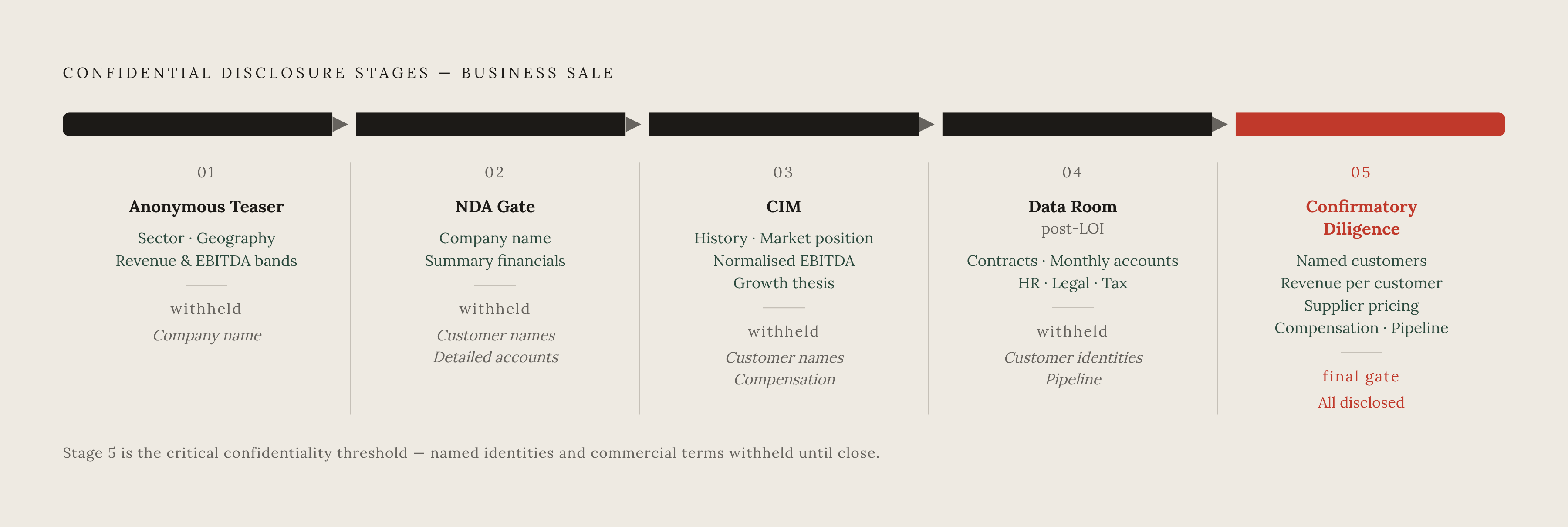
Lyndon describes a confidential sale as five disclosure stages. Stage 1 is the anonymous teaser, which introduces the opportunity without identifying the company. Stage 2 is the NDA gate, after which the company name and summary financials become available. Stage 3 is the Confidential Information Memorandum, or CIM, which presents the detailed business narrative, historical performance and market position.
Stage 4 opens the data room for contracts, monthly accounts, HR, legal, tax and diligence materials. Stage 5 is confirmatory diligence, when a serious buyer gets details about customers, suppliers, employees and the pipeline under clear rules for the process. Advancement remains conditional after initial interest. Multiple buyers can move through the early stages in parallel, preserving competition before the most sensitive release. The sequence is only as strong as its weakest gate.
What the anonymous teaser must — and must not — reveal
The teaser circulates before any confidentiality obligation exists. Its boundaries therefore need to be exact. “Southern Ontario manufacturing” gives a buyer sector and general geography without naming a company or city. Broad revenue and EBITDA bands help buyers judge the financial fit, and a general account of growth drivers, the customer model and competitive position explains the investment thesis.
The company name, brand and identifiable location stay out, as do named customers, suppliers and employees. The distinction is between useful qualification and identification. Would naming a city help a buyer judge the acquisition, or just make the seller easier to recognize? Some owners worry that anonymity weakens interest, but a carefully constructed teaser is not an empty description. Extra specificity at this stage trades confidentiality for response volume, with any gain in buyer quality uncertain.
How the NDA gate works and what its clauses must actually protect
The NDA is the transaction’s first binding commitment. A precise definition of confidential information limits enforcement gaps, while a use-limitation clause protects against competitive intelligence gathering by restricting information to evaluating the purchase. Non-solicitation provisions address approaches to employees, customers and, in certain cases, suppliers during and after evaluation.
A separate no-contact clause requires written seller consent before the buyer approaches employees, customers, suppliers or the landlord. Contact and solicitation are distinct risks to control. Permitted onward disclosure is limited to the buyer’s lenders, attorneys and accountants, each bound by the same terms. After execution, disclosure to the buyer is limited to the company name and summary financials to confirm fit.
Protection must also extend beyond a failed negotiation. A competitor who reviews the CIM and withdraws should remain bound by applicable restrictions on recruiting the sales team or approaching customers. Enforceability is not identical across every Canadian transaction. Provincial employment and contract law affects the terms, so sellers should have a business sale lawyer review the NDA before distribution.
What the CIM discloses, and why its construction determines buyer quality
The CIM turns preliminary interest into the basis for a credible offer. Breakwater describes its scope as company history, financial performance, growth opportunities, market positioning, management and the investment thesis. Customer names, supplier contracts, employee compensation and pipeline detail stay out of this document and are shared later under controls on access.
The valuation argument rests first on normalized EBITDA. Owner compensation above market rate, personal expenses, one-time fees and non-recurring operating costs are added back to show earnings capacity. Recurring revenue should stand out because buyers see subscriptions, service contracts and retainers as less risky than transaction-based revenue. An independent sell-side Quality of Earnings report validates adjusted EBITDA and reduces the risk that diligence reopens the price negotiation.
Presentation also influences who takes the opportunity seriously. Breakwater notes that institutional buyers treat the advisor’s work product as a signal of deal quality. A thin or disorganized CIM can depress the caliber of offers even when the underlying company is attractive. Calibrated disclosure therefore protects more than confidential facts. It gives credible buyers enough evidence to value the business without prematurely exposing the relationships behind its revenue.
How the data room controls access without slowing the deal
The data room is an access-control system. Entry follows an LOI submission or demonstrated seriousness. Signing an NDA does not entitle every buyer to inspect contracts, monthly accounts, HR documents, legal filings and tax returns. Folder-level permissions allow financial records to be released before HR or customer materials, extending the sequence within the room itself.
Specific customer names, supplier terms, individual compensation and pipeline detail remain gated for confirmatory diligence. Work on the documents starts months before buyers get access. Clearview Counsel identifies missing or incomplete corporate records as a common diligence problem, making articles of incorporation, shareholder agreements, minute books, resolutions and certificates of status part of that early work. Lease transferability and landlord consent requirements also need review before the room is populated.
This preparation prevents access control from becoming a scramble. Material customer and supplier contracts need their change-of-control provisions identified and disclosed, rather than left for buyers to discover and use as price-reduction leverage. A landlord’s refusal to consent to assignment can threaten the transaction late in the process. An LOI does not eliminate these risks. A deal can still unravel after the parties have moved toward agreement.
Confirmatory diligence and the controlled release of the most sensitive information
Stage 4 supports verification of the CIM, while Stage 5 reveals the identities and terms behind its claims. The increase in specificity is substantial here. Buyers learn who the customers are and how much revenue each brings in, see named supplier contracts and pricing, and get details of individual compensation, retention arrangements, the pipeline and forward orders. Release occurs under defined rules intended to make misuse detectable and legally actionable.
The NDA’s no-contact clause remains central during diligence. The buyer’s team still needs written consent to approach customers, employees, suppliers or the landlord. Key managers may participate where required, but under clear confidentiality obligations. Their involvement does not turn the proposed sale into general internal knowledge.
The solar installation case illustrates why seriousness must include financing capacity. The company lost a qualified buyer while granting exclusivity to an unfinanced group. Its commercial exposure and confidentiality exposure were inseparable. Tightening the final document release must be accompanied by discipline at the preceding gates to reach this point with one qualified, well-vetted buyer.
How internal communication timing protects the deal from inside the business
An employee may hear about the sale through the owner’s assistant, changing advisor traffic or an overheard call. The buyer’s NDA does not control those channels. Internal disclosure therefore needs its own plan, with role governing access regardless of seniority or loyalty.
The owner and sell-side advisor know from the outset, while the personal accountant and lawyer join early for tax and legal preparation under professional confidentiality obligations. Key managers enter at confirmatory diligence only when presentations or operational questions require them, under written agreements. Other employees, customers and suppliers learn after signing or through the transition communication plan. Employees who hear about the sale early may use that knowledge to seek retention bonuses before there is a deal. Buyers may then treat that obligation as a liability.
Signing does not remove the need for coordination. Buyer and seller should pre-agree announcement timing and sequencing in the definitive agreement. Employees need clarity about continuity, customers about service, and suppliers about contractual relationships. Internal communication therefore requires formal coordination as part of transaction design.
How do Canadian SMB owners find qualified buyers without word getting out?
A vetted buyer network protects information only if buyers are checked for more than their interest in a purchase. Financial capacity means confirmed access to the capital required to close. Strategic fit means a plausible acquisition rationale. Process credibility includes whether the buyer has advisors with a record of closing transactions in the relevant size range.
These criteria turn screening into a confidentiality control. An unfinanced buyer’s LOI can lack credibility as a commitment and become an option on the seller’s time and information. A competitor without financing may value the intelligence more than the acquisition. The solar installation case shows the cost of confusing exclusivity with readiness to close.
A single unsolicited approach also weakens the seller’s ability to test credibility against alternatives. Competition provides more than negotiating leverage on price. It lets the seller compare buyers before deciding who should get more access. Qualification cannot replace contractual restrictions, but it reduces reliance on those restrictions by narrowing sensitive disclosure to people with a credible reason and capacity to complete the purchase.
The pre-market preparation that makes confidentiality possible before the process begins
The disclosure sequence is built before the teaser goes out. Disorganized records and unresolved legal issues force improvised answers during diligence, creating pressure to release information out of order. Preparation is therefore part of confidentiality itself. Advisor Standard places financial cleanup and EBITDA normalization first among its preparation areas, supporting both the CIM’s earnings narrative and the later verification buyers and lenders require.
Corporate records protect the data room stage from avoidable governance questions. Buyers may have grounds to renegotiate if minute books are missing, director appointments have gone unrecorded or share registers are incomplete. Documented SOPs, delegated responsibilities and written workflows address a different weakness, dependence on the owner’s personal relationships. They help show that operations form a system. Lease and contract review, in turn, addresses assignment and change-of-control obstacles before access begins.
These changes need room to take effect. Clearview recommends starting preparation two to three years before a planned exit, allowing issues to be resolved without buyer pressure. An exit readiness review typically begins well over a year before a formal launch. Clean records and documented operations reduce the reasons a buyer might demand accelerated access to sensitive information simply to understand how the business works.
Why the protocol sequence compounds value, and where to start
Competitive interest gives the seller alternatives when enforcing access conditions. A well-drafted NDA supports a fuller value narrative, while a CIM backed by a sell-side Quality of Earnings report reduces diligence uncertainty. An organized data room then reinforces the operational discipline that valuation assumes. Shortcuts weaken those downstream benefits, even when the immediate disclosure appears harmless.
Building and enforcing that system is the advisor’s role. An advisor combining AI-driven buyer matching with institutional investment banking expertise can manage private outreach, NDA execution, CIM construction, data room access and buyer qualification. Technology identifies possible matches, while advisory work governs advancement through the gates. This gives founder-led businesses a confidentiality process of the kind used by institutional buyers, without having to start with a public listing.
Begin with an exit readiness review. Tax planning also needs to start well ahead of the sale because the qualifying conditions for the Lifetime Capital Gains Exemption must be met before closing. Owners who first engage a tax advisor weeks before signing an LOI are typically too late to restructure for qualification. When the business might sell and how much preparation time remains are therefore both useful questions. An owner with time can resolve the weaknesses privately, before any buyer gains the leverage to expose them.