Why Vetted Buyer Networks Outperform Open Marketplaces for Canadian SMB Exits Under Fifty Million
Screened buyer networks beat open listings on price and certainty of close.

A Canadian SMB can use a confidential sale through an M&A adviser or vetted buyer network to reach screened acquirers without listing the business in public. In a market short on qualified buyers, screening for acquisition fit, capital source, and closing capability makes channel choice a determinant of both price and certainty of close.
Why Canadian SMB sellers face a structurally thin buyer market
The Canadian Federation of Independent Business calls the approaching wave of owner exits a “succession tsunami,” with a large share of owners planning to leave within the next decade and trillions in business assets in motion. Business exits have outpaced new business entries in Canada since early 2024. That imbalance is broader than the acquisition market, but it frames owners' difficulty in finding successors. Owners who want to sell cannot count on enough buyers having the funds to buy their businesses. Retirement creates a reason to sell.
CFIB’s Passing the Torch report identifies finding a buyer or suitable successor as the most frequently cited succession challenge. It ranks ahead of determining business value or finding time to plan. This structural constraint persists beyond a favourable moment in the cycle. A business can still meet its customers' needs even when there is no clear successor. Its owner's timetable and a potential acquirer's requirements are separate things.
The retirement consequences make that distinction especially important. Canadian small business owners depend heavily on the money from selling their businesses for income in retirement. CFIB senior director of research Marvin Cruz put the risk directly. “If they can't find a buyer, they may have to delay retiring or close the business altogether”. The seller's task is therefore not simply to announce availability, but to reach the comparatively scarce buyers capable of taking over.
A qualified buyer is funded, focused, and capable of closing. Each word describes a different test. Funding is the capital a buyer has to complete the acquisition, while focus is how well the business fits the buyer's acquisition criteria. Closing capability extends beyond interest or an attractive initial offer. It includes the ability to remain engaged through the financial review, documentation, and financing work that precede a completed transaction.
Portage M&A Advisory describes extended closing timelines driven by lender diligence, quality-of-earnings reviews, and increased documentation requirements. Those demands distinguish a prospective acquirer from someone merely exploring ownership. Can the buyer sustain a process in which the financial picture must withstand repeated scrutiny? A seller cannot answer that question from an inquiry alone. At this deal size, a serious expression of interest is the start of qualification.
Portage also describes buyers as more selective while remaining active for businesses with reliable financial performance, low customer concentration, strong management, and recurring revenue. It calls the environment “a strong market for sellers who prepare well and present a clean, stable, and transition-ready business”. Strategic buyers may want cost and revenue synergies, a larger business, and access to low-cost financing. They have the capacity to pay a premium. Their willingness to do so depends on being able to underwrite the business with confidence.
How open marketplaces attract volume but filter out the buyers who can close
With free buyer access, people can ask about a business without first showing they are ready to buy it. That makes an open marketplace accessible, but accessibility and qualification are different functions. A browser can express interest without first stating a credible capital source or a defined acquisition mandate. The seller receives attention before evidence of capability. High inquiry counts can therefore conceal a weak pool of prospective acquirers.
Open-marketplace financials are largely self-reported and are not audited by the platform. Buyers inherit the verification burden. For a serious buyer, an undifferentiated listing offers limited help in deciding whether that work is justified. For someone not yet ready to check the business's numbers, that lack of help does little to hold them back.
This is how volume can select for curiosity. The channel leaves filtering to the seller while giving diligence-capable buyers little assurance at the point of discovery. The resulting “tire-kicker” traffic is a process cost. Time spent responding to unqualified interest does not bring the owner closer to a funded counterparty.
Open boards can offer a reasonable reach-for-filtering trade-off for a Main Street business at a $350,000 median price point. Lower-middle-market transactions pose a different problem because confidentiality, buyer credibility, and deal structure become central. Public exposure may broaden awareness without improving the relevant buyer pool. For these sellers, gated networks and M&A advisers are the more appropriate channels.
How can sellers find qualified buyers without publicly listing their business?
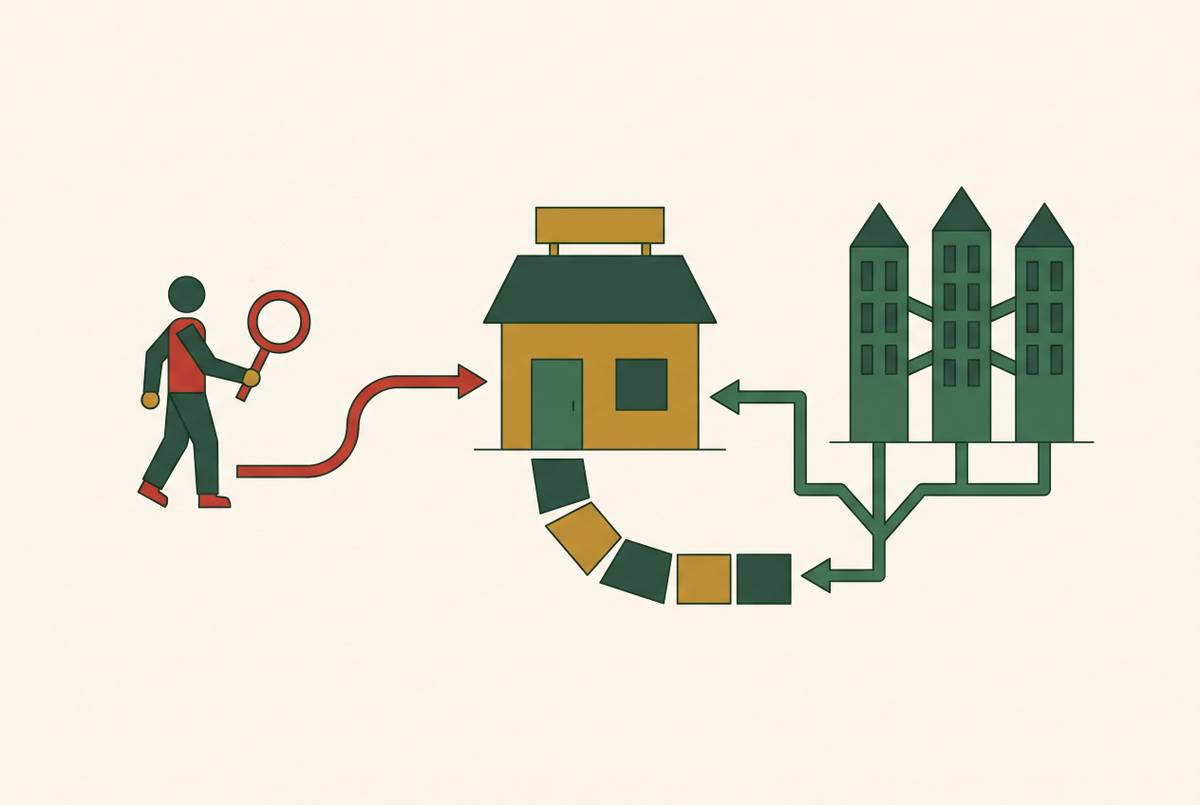
A gated network screens buyers before showing them a deal. Entry requires a written buy box specifying acquisition criteria, deal size, and capital source. That requirement gives the seller a basis for distinguishing a relevant acquirer from a browser before exposing business information. It also changes what a match means. A buyer is relevant because their stated mandate fits the opportunity.
The sell-side adviser markets the business under NDA to a screened buyer list rather than relying on a public listing to attract interest. Confidentiality becomes part of the process design. The aim is to keep employees, customers, and competitors from learning of the sale before completion. An NDA cannot guarantee that no one will disclose the sale, but controlling who sees it is very different from listing it in public.
The quality of the information presented is another mechanism. Verified financials and operations leave buyers with fewer unknowns to work through before they assess the business. The seller gains evidence about the buyer's capacity, while the buyer gains a firmer basis for evaluating the seller's claims. Lower perceived risk can support stronger offers, although it does not establish a universal price premium for every vetted transaction.
The useful measure is therefore pursuit rate. How many buyers took a qualified next step beyond seeing the business was for sale? That question connects channel performance to the work of completing a sale. A large audience is of limited use if few members have the mandate or resources to proceed. A screened network is better aligned with qualified pursuit because its admission and matching criteria address those requirements before an introduction.
What sellers get wrong about valuation before they choose a channel
IBBA adviser data shows that sellers expecting more than their businesses are worth is one of the main reasons deals fail to close. This introduces a limit to the channel argument. A vetted network can improve access to qualified buyers, but it cannot make an unsupported valuation survive their diligence. Better buyers usually mean more serious scrutiny. The seller's financial presentation must be ready for the audience the channel delivers.
One common error is treating annual revenue as a valuation. Sales do not establish what remains after the business pays its costs, so a business is not automatically worth its annual sales figure. A related error is importing a large-company multiple into a small private transaction. A 10× EBITDA multiple associated with large strategic acquisitions is not a general rule for smaller businesses, where a 2×–4× SDE multiple may be more realistic. These measures describe different earnings bases and business profiles.
Personal expenses and one-time items may increase the earnings figure a seller presents, but only if they withstand diligence. A rejected add-back reduces the earnings base to which the valuation multiple applies. Its effect on price is therefore multiplied. Owner dependency can also compress the multiple when revenue, relationships, or operations depend heavily on the departing owner, producing a reduction in enterprise value that can exceed the earnings figure itself.
Alison Anderson, Founder and CEO of SuccessionMatching.com, says, “Most deals break down during the negotiation because business owners are not actually ready on paper to transition their business”. The practical response is to begin exit planning 18–36 months before the target sale date. That period gives owners time to address operational weaknesses, build documentation, and present their financials at their best. Preparation is what allows a qualified buyer to assess the business the seller believes is being offered.
Industry-specific factors that make vetted networks more important in Canadian food and manufacturing exits
In food, beverage, and manufacturing, acquisition fit depends on details a general listing cannot interpret for a seller. Canadian food and beverage businesses are becoming more sought after when they manufacture at home, have established Canadian supplier networks, and have little exposure to sourcing across borders. Strategic buyers and private equity investors now value supply chain resilience more. The buyer's perspective is consequential here. An operating feature that looks ordinary in a listing may be central to an acquirer's strategy.
Prepared and convenience food businesses illustrate why broad valuation rules need qualification. These businesses can command 7–10× EBITDA, with premiums for proprietary recipes and direct grocery relationships. High SKU complexity, short shelf life, and single-customer concentration can attract discounts.
What does a particular buyer understand about those attributes? A buyer who knows the sector can judge whether grocery relationships, recipes, or supplier networks fit the acquisition they have in mind. A vetted network and its advisers can use that intelligence when selecting prospective acquirers. An open marketplace supplies exposure. The advantage lies in matching operating strengths to a buyer able to recognise and underwrite them.
Farm Credit Canada's 2026 Food & Beverage Report says tariffs are a major challenge, with higher costs for border administration, regulatory compliance, and packaging even for tariff-free products. Supply chain positioning consequently becomes a diligence issue. Elevated buyer interest also extends to technology, financial services, and industrial manufacturing and distribution. Strategic consolidation is not confined to food. Across these sectors, selecting between strategic and financial buyers, or domestic and cross-border buyers, can influence how a business's strengths and risks are valued.
How formal planning and the right channel reinforce each other — and what happens when neither exists
Planning and channel selection solve different problems, but their effects reinforce each other. Planning makes a business ready for transfer, while a suitable channel brings that business to buyers able to assess and fund the transition. Neither works fully in isolation. Prepared financials cannot create a buyer relationship on their own, and a screened buyer list cannot resolve undocumented earnings or dependence on the owner. Treating these choices as separate leaves a gap between what a business is worth and a sale that closes.
The cost of that gap extends beyond price. Roughly one in eight Canadian owners expects to close rather than sell, rising to roughly one in six among retailers. Without a formal plan, the risks extend to jobs, families, and local economic stability, as well as the owner's retirement.
Owners who plan ahead start before they need to sell urgently. Hub Equipment President Tom Stevenson spent several years considering exit options, illustrating the lead time that an owner can give the decision. CFIB's partnership with SuccessionMatching provides a more direct example of connecting planning with buyer access. It links owners looking to sell with entrepreneurs looking to buy, while offering members a discount on the formal Succession Planning program and a free one-year membership.
A prepared business gives screened acquirers something they can evaluate with confidence, while a confidential process limits exposure to a relevant audience. That combination connects the owner's work on the business to a credible route out of it. In a Canadian market structurally short on qualified buyers, the sale channel is part of the exit itself.