What Happens to Your Business Equity When You Sell as a Non-Citizen in Canada
Non-resident sellers face immediate withholding on gross sale proceeds, not profit.

When a non-resident sells a Canadian business, the equity built up over years does not simply land in a bank account at closing. Section 116 of the Income Tax Act triggers mandatory withholding on the gross proceeds of the sale, not the profit, and that single mechanical fact reshapes the entire transaction, from deal structure to timeline to how much cash actually shows up on closing day.
Residency status, not citizenship or passport, triggers Canadian tax obligations on a business sale
Canadian tax law runs on residency, full stop, and citizenship has almost nothing to do with it. A Canadian passport does not make its holder a Canadian resident for tax purposes, and holding a foreign passport does not automatically make someone a non-resident either. What matters is where a person actually, normally, customarily lives.
That sounds tidy until the "deemed non-resident" category enters the picture. This arises when a tax treaty between Canada and another country treats someone who would otherwise qualify as a Canadian resident as a resident of that other country instead. It is a subtler category, and one that trips up business owners who assumed their Canadian ties (a home, a bank account, family still living there) settled the question in Canada's favor.
Owners who have relocated, who split time between two countries, or who have restructured personal or corporate affairs across borders, may genuinely not know which category they fall into Welch LLP / Non-Residents Selling Property Birdi Chartered Professional Accountant KSSP Blog Zinatikay Clear Wealth Tax Non-Resident Withholding Tax Canada: Section 116 Sale Of Property. Whether everything else in this piece, the withholding, the lost exemption, the deemed disposition traps, applies depends on it. Physical presence alone does not resolve the question, and neither does a gut sense of where "home" is. Residency determination is a technical exercise, and it is the prerequisite step, before any listing agreement gets signed, before any letter of intent gets negotiated. A non-resident is defined as someone who normally, customarily, or routinely lives in another country and is not considered a Canadian resident for tax purposes.
Section 116 of the Income Tax Act puts the buyer, not just the seller, at legal risk
Section 116 triggers mandatory withholding on gross proceeds, not just profit, when a non-resident sells a Canadian business, creating cash flow consequences and compliance steps. Its core purpose is to make sure non-resident sellers who dispose of taxable Canadian property report that disposition to the CRA and pay whatever Canadian tax is owed. A non-resident vendor may have no other assets sitting in Canada once the sale closes, which leaves the CRA with limited practical means to chase down unpaid tax after the fact.
So the law shifts the risk onto the one party still standing in Canada with money in hand: the buyer. If a buyer fails to withhold the required amount and remit it, the buyer becomes personally liable for the vendor's capital gains tax, a statutory default treated as non-negotiable at closing by every buyer's lawyer.
This is not confined to real estate transactions, either. Section 116 also applies when a non-resident sells an assignment of a pre-construction purchase agreement, or sells shares of a corporation whose value derives principally from Canadian real property. That second category puts business owners squarely in scope alongside condo investors flipping units before occupancy.
From the seller's chair, the equity built into the business is effectively held hostage until the compliance machinery runs its course, and that holding pattern is the thread connecting Section 116 to every dollar-and-cents consequence that follows.
Withholding on gross proceeds, not profit, creates an immediate cash flow shock at closing
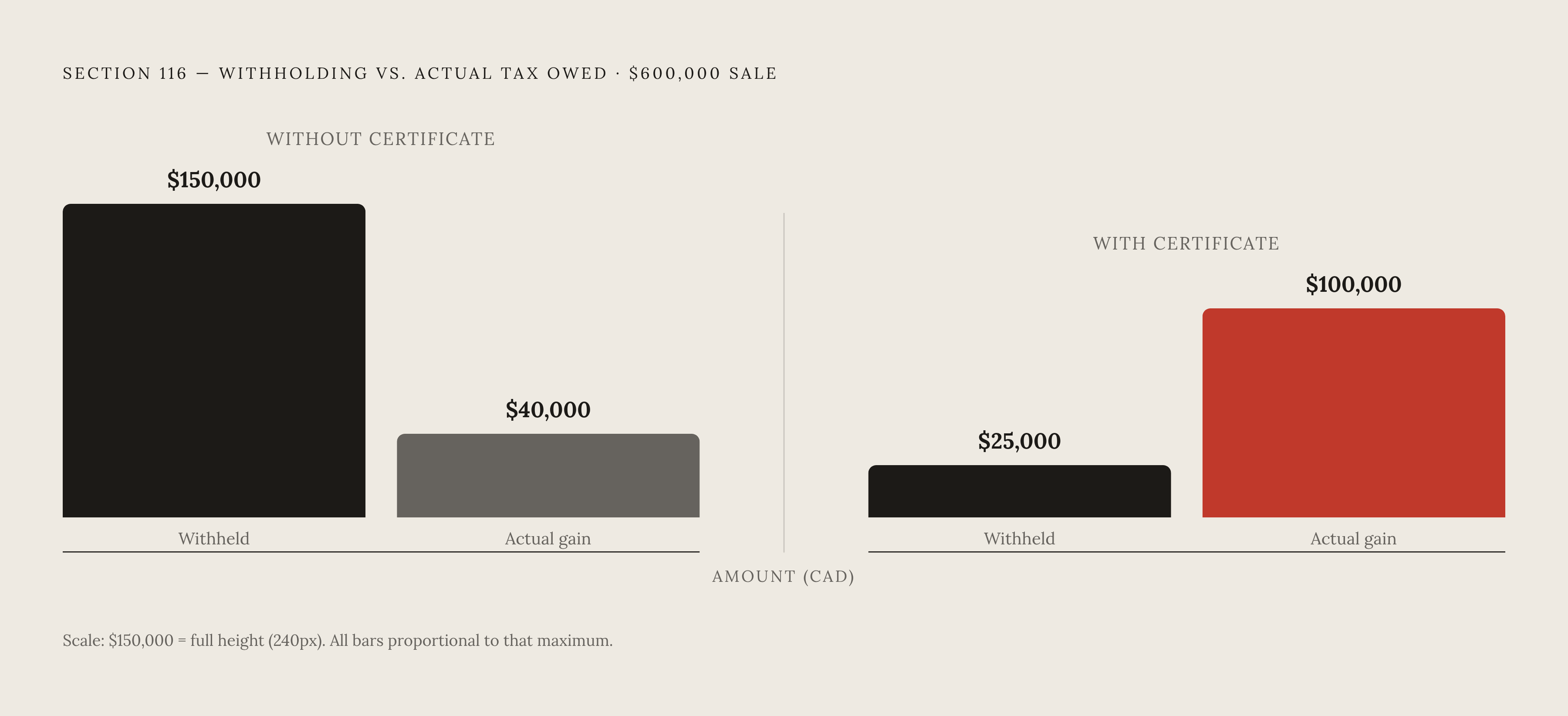
The withholding calculation runs against the gross sale price Welch LLP / Non-Residents Selling Property KSSP Blog Zinatikay WealthNorth Non-Resident Withholding Tax Canada: Section 116 Sale Of Property Tax Considerations on Sale of Property by Non-Residents (T2062) - CIS Tax. Sell a property for $600,000 and $150,000 gets withheld at the standard 25% rate, even if the seller's actual profit on the deal was only $40,000 Welch LLP / Non-Residents Selling Property KSSP Blog Zinatikay WealthNorth Non-Resident Withholding Tax Canada: Section 116 Sale Of Property Tax Considerations on Sale of Property by Non-Residents (T2062) - CIS Tax. The same logic carries over to business share sales wherever Section 116 applies, and the gap between what gets withheld and what is actually owed in tax can be enormous.
The standard rate is 25% of gross proceeds for non-depreciable property, and that is the figure buyers' lawyers are applying at closing tables today Welch LLP / Non-Residents Selling Property KSSP Blog Zinatikay Tax Considerations on Sale of Property by Non-Residents (T2062) - CIS Tax. Where depreciable property is involved, say, a building on which capital cost allowance has already been claimed, the rate jumps to 50% of gross proceeds Stern Cohen Insights CPA Non-Resident Withholding Tax Canada: Section 116 Sale Of Property Tax Considerations on Sale of Property by Non-Residents (T2062) - CIS Tax. That matters for business sales that include real estate as part of the package, not just for pure real estate transactions.
Draft legislation released June 10, 2024 would have raised the withholding rate from 25% to 35% for dispositions on or after January 1, 2025, as part of a broader package that also would have moved the capital gains inclusion rate to two-thirds Welch LLP / Non-Residents Selling Property Birdi Chartered Professional Accountant KSSP Blog Zinatikay Clear Wealth Tax Non-Resident Withholding Tax Canada: Section 116 Sale Of Property. That inclusion rate increase was cancelled March 21, 2025, and the withholding rate increase was never separately enacted Welch LLP / Non-Residents Selling Property Birdi Chartered Professional Accountant KSSP Blog Zinatikay Clear Wealth Tax Non-Resident Withholding Tax Canada: Section 116 Sale Of Property. As of the most recent reporting available, the CRA has not issued formal guidance confirming the 35% rate applies, is deferred, or has been abandoned Welch LLP / Non-Residents Selling Property Birdi Chartered Professional Accountant KSSP Blog Zinatikay Clear Wealth Tax Non-Resident Withholding Tax Canada: Section 116 Sale Of Property.
Once withheld, the buyer does not get to sit on the funds indefinitely. Remittance to the CRA is due within 30 days of the month end in which the sale closed, and missing that deadline triggers a 10% penalty on the required withholding amount, assessed against the buyer Practical Law Thomson Reuters Crowe MacKay. For the seller, the practical upshot is blunt: a meaningful chunk of the sale proceeds simply will not be sitting in the seller's account on closing day. Liquidity planning has to account for that gap well before a purchase agreement gets signed.
The clearance certificate process: the main lever for reducing what gets withheld before the deal closes
If gross-proceeds withholding is the problem, the clearance certificate is the closest thing to a fix. Applying for a Section 116 certificate can drop withholding from 25% of the gross sale price down to roughly 25% of the net capital gain, which is a different order of magnitude entirely WealthNorth. On a $600,000 sale with $100,000 of actual profit, $150,000 is withheld versus roughly $25,000 WealthNorth.
Getting there means navigating a small forest of forms. T2062 covers general dispositions, T2062A comes into play when depreciable property is involved, and the CRA issues either a T2064 (where tax is paid or secured before closing) or a T2068 (where it gets settled afterward). Timing carries real teeth: the seller must notify the CRA within 10 days after closing, and late notification carries a $25-per-day penalty, with a minimum of $100 and a maximum of $2,500, applied even where no tax ends up being owed.
The smarter route, where the timeline allows for it, is proactive rather than reactive. Under subsection 116(1), a vendor can submit notice for a proposed disposition before the sale even closes, and the CRA recommends sending that notice at least 30 days ahead of the actual disposition to leave room for review Practical Law Thomson Reuters. Where conditions are met, the CRA can issue the T2064 before closing rather than after, which changes the entire cash flow picture for the seller.
Per multiple practitioner sources, the CRA currently takes approximately 4 to 6 months to process T2062/T2062A requests and issue the certificate, as post-pandemic backlogs have extended timelines that previously ran roughly 4 months at most Crowe MacKay. While an application sits in the queue, the CRA typically issues what practitioners call a comfort letter, confirming the buyer can keep withholding at 25% without incurring interest or penalty exposure until the actual certificate arrives. The funds only get released once that certificate, not the comfort letter, is in hand, and in complex cases that wait can stretch beyond a year.
A process that takes approximately 4 to 6 months rewards sellers who start before listing the business, not after a deal is already signed Crowe MacKay. Waiting until there is a firm agreement in place all but guarantees a delayed release of funds at exactly the moment liquidity matters most. To prepare for the clearance certificate process, the seller needs the agreement of purchase and sale, the original purchase agreement, proof of adjusted cost base (purchase price plus documented capital improvements), rental income history if applicable, and a Canadian tax identification number, with no SIN meaning Form T1261 must be filed for an Individual Tax Number first.
The Lifetime Capital Gains Exemption that non-residents cannot use
Resident sellers of a Canadian business have access to a genuinely powerful tool that non-residents simply do not. For 2026, that exemption is $1,275,000 per individual, indexed up from $1,250,000 in 2025 PwC Tax Summaries. A separate proposal, the Canadian Entrepreneurs' Incentive, was floated and then cancelled in Budget 2025, so it never became law, leaving the $1,275,000 figure as the confirmed, operative number PwC Tax Summaries. The capital gains inclusion rate itself remains at 50%, since the proposed increase to two-thirds from Budget 2024 was also cancelled and never passed Stern Cohen Insights CPA Clear Wealth Tax.
None of that helps a non-resident. The exemption is available only to individual Canadian residents, full stop, and corporations, most trusts, and non-residents are explicitly barred from claiming it. This produces what might be called the departure trap: an owner who becomes a non-resident before the disposition loses the LCGE on that sale even if the business property remains in Canada. The exemption tracks the seller's residency status at the moment of sale, not where the underlying asset happens to sit.
On a significant business sale, losing the LCGE can eliminate $300,000–$500,000 in personal tax that a resident seller in the identical transaction would never have owed Practical Law Thomson Reuters WealthNorth. That is arguably the single most direct, most quantifiable expression of the non-resident tax disadvantage anywhere in this entire framework.
A resident seller would need, to qualify in the first place: shares in a Canadian-controlled private corporation, at least 90% of company assets used in an active business at the time of sale, a 24-month holding period, and a handful of other tests Dougan Irwin Clear Wealth Tax. A non-resident cannot clear any of these bars because the residency requirement comes first and forecloses the analysis before it starts Dougan Irwin Clear Wealth Tax.
Share sale versus asset sale: how deal structure interacts with non-resident tax status
Selling a Canadian business generally comes down to one of two structures: a share sale, where the shareholder sells shares directly, or an asset sale, where the corporation sells its underlying assets. For a non-resident, the arithmetic differs sharply between them.
In a share sale, capital gains tax applies at the 50% inclusion rate on the gain between selling price and adjusted cost base, no corporate-level tax gets triggered, Section 116 withholding applies on the gross proceeds, and the LCGE remains off the table Stern Cohen Insights CPA. The entire gain is taxable with no shelter available, which is a hard number to look at but at least a comparatively simple one.
Asset sales complicate things further, and often not in the seller's favor. Buyers frequently prefer asset deals because they get a stepped-up cost base on the assets acquired and sidestep inheriting the corporation's existing liabilities. That preference lands harder on a non-resident. Asset sales carry a double-tax layer: the corporation pays tax on each asset sold at the corporate level, and then the shareholder pays personal tax again when extracting the remaining proceeds through dividends or other distributions.
A resident seller doing a share deal can shelter up to $1,275,000 of gain with the LCGE, while a non-resident in the identical share deal gets nothing sheltered PwC Tax Summaries. Yet the share deal still sidesteps the asset route's double-tax layer, which makes it, on balance, typically the less punishing option for a non-resident seller even without exemption relief PwC Tax Summaries. And regardless of which structure gets chosen, Section 116 triggers mandatory withholding on gross proceeds and does not go away. It applies in either structure wherever taxable Canadian property is involved. Structure alone cannot solve mandatory withholding on gross proceeds; it can only change how badly the tax bill stings once the withholding gets sorted out.
The deemed disposition trap: owners who left Canada before selling may face two separate taxable events
Timing residency changes around a planned sale carries its own hazard, easy to overlook until it is too late to plan around. Under subsection 128.1(4) of the Income Tax Act, when someone ceases to be a Canadian resident, that person is deemed to have disposed of specific property at fair market value on the date of departure, and to have immediately reacquired it at that same value. In effect, departure itself is treated as a sale, even where no actual transaction has occurred.
What this means practically is that capital appreciation accrued during the years of Canadian residency gets taxed at the point of departure, on the CRA's position that it retains the right to tax gains earned while someone was a resident, regardless of whether an actual sale ever took place. When that is combined with a later, genuine sale under Section 116, an owner can face two separate taxable events tied to the same underlying business: tax on the deemed disposition at the date of departure, and tax again on the real sale once it happens.
That does not amount to double taxation on the identical dollar of gain, since the deemed disposition resets the adjusted cost base to fair market value as of the departure date. But departure itself creates an immediate filing obligation and potential tax bill that has to be planned for well ahead of any actual sale. There is a sliver of relief buried in the sequence, too: if the owner was still a Canadian resident on the date of the deemed disposition and held qualifying shares, the LCGE may still apply to the departure-day gain, just not to whatever appreciation accrues afterward as a non-resident. That single fact creates a real incentive to think hard about the order of operations, sell first or depart first, since the sequencing can change the after-tax outcome substantially.
Tax treaty relief and its limits for business equity
Tax treaties offer a partial counterweight to all of this, though the emphasis has to land on partial. As a general rule, non-residents owe Canadian tax on capital gains only where the property in question qualifies as taxable Canadian property and the seller has no applicable treaty relief available. Canada maintains tax conventions with a wide range of countries specifically to prevent double taxation, and where a seller resides in a treaty country, that treaty can reduce or eliminate Canadian withholding or capital gains tax on certain categories of property.
But treaties tend to focus on wages, salaries, pensions, interest, and dividends, and the extent of protection for business share gains varies considerably from treaty to treaty and asset to asset. What treaties do not touch is the LCGE. The exemption functions as something other than a withholding mechanism. It is a domestic Canadian deduction, available only to Canadian-resident individuals, and no treaty provision restores that eligibility for a non-resident seller. The $1,275,000 shelter stays gone regardless of where the treaty analysis lands PwC Tax Summaries.
Shares may or may not count as taxable Canadian property in the first place. Whether Section 116 applies depends on whether the corporation's value derives principally from Canadian real property. Where shares do qualify as taxable Canadian property, treaties may still permit Canada to tax the resulting gain, so treaty relief is not a blanket exemption even in the best case. Treaty analysis is fact-specific and country-specific enough that it requires professional review; it functions as a possible partial offset to the disadvantages outlined above.
One further compliance layer deserves mention for sellers who held residential property alongside the business. The Underused Housing Tax is a separate 1% annual tax on the value of vacant or underused residential property owned by foreign nationals who are neither citizens nor permanent residents, and failing to file a UHT return brings penalties of at least $5,000 for individuals, or 5% of the UHT payable. Anyone selling a business who also held residential property in Canada needs that obligation cleared before the file is considered closed, not treated as an afterthought once the main sale is done.
Sources
- Navigating Canadian Taxes for Non-Residents Owning Real Property: An Overview
- Non-Residents Selling Property in Canada | Crowe MacKay
- Non-resident Selling property in Canada 2025 - Birdi Chartered Professional Accountant
- Tax Tips For Non-Residents Selling Canadian Real Estate | Blog
- Non-Resident Withholding Tax Canada: Section 116 Sale Of Property
- Tax Considerations on Sale of Property by Non-Residents (T2062) - CIS Tax
- Advice for Non-residents Selling Canadian Real Estate | Stern Cohen
- Section 116 Clearance Certificate - Practical Law